You have not yet added any article to your bookmarks!
Join 10k+ people to get notified about new posts, news and tips.
Do not worry we don't spam!
Post by : Rohit Dhiman
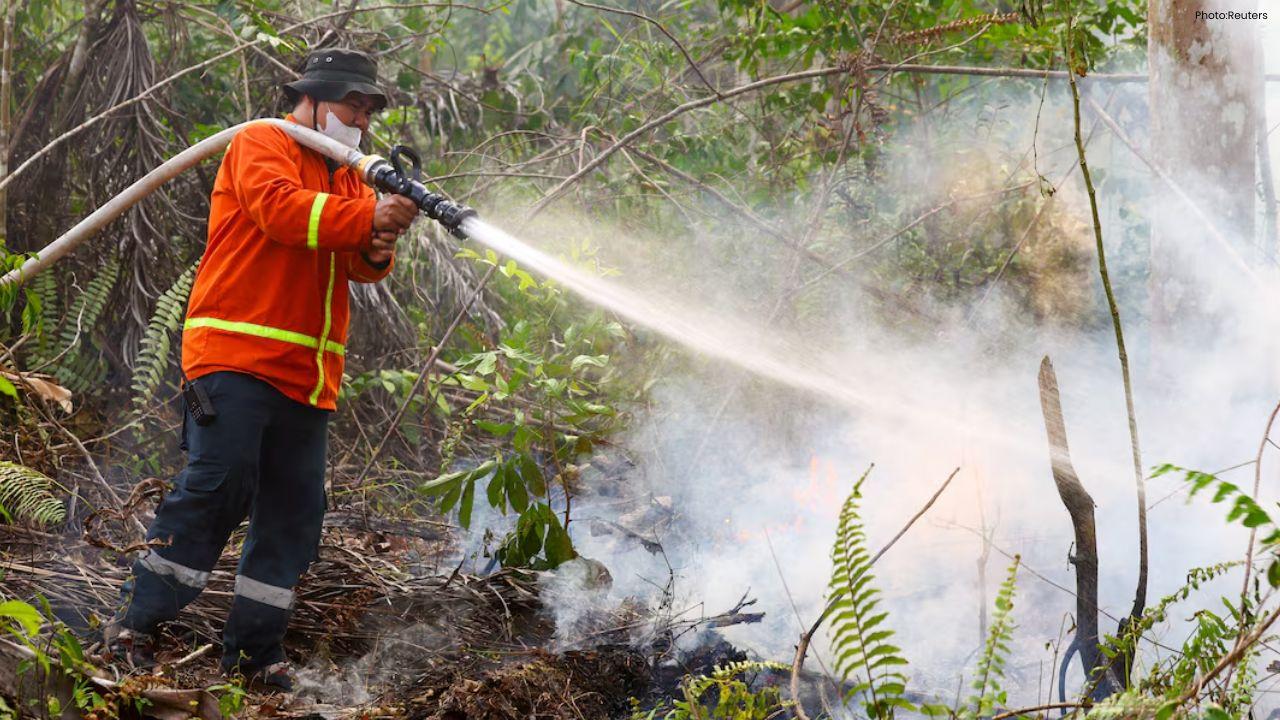
Wildfires are spreading across areas surrounding Indonesia’s under-construction new capital, Nusantara, raising concerns about the impact of worsening dry conditions on the ambitious development project. Authorities have intensified efforts to control fires after several areas around the new capital territory were affected. Officials have also called for additional measures, including water-bombing operations and cloud seeding, to help contain the flames and encourage rainfall. The situation is developing during what disaster-response officials describe as one of Indonesia’s most difficult dry seasons in roughly a decade. The conditions have been made more challenging by a powerful Super El Nino, which has contributed to hotter and drier weather across parts of the country.
One of the most serious fires has been reported in the Bukit Suharto forest park, also known as Suharto Hill, in East Kalimantan. Officials said approximately 300 hectares of land in the forest area had been burned. Bukit Suharto is located about 50 kilometres from the centre of Nusantara, where major infrastructure and government-related projects have been constructed as part of Indonesia’s plan to establish a new administrative centre. Overall, fires had affected around 400 hectares in areas surrounding Nusantara by September 2, according to disaster-response officials. The spread of the fires has increased concerns about the vulnerability of forests surrounding the new capital, particularly as dry weather continues and water resources remain limited.
The fires around Nusantara are part of a much larger wildfire problem affecting Indonesia. Authorities have been working to contain forest fires and land fires across several provinces on the islands of Borneo and Sumatra. The total area affected by fires across the country has reached more than 73,000 hectares. The dry season has made vegetation more vulnerable to ignition, while limited rainfall is making firefighting operations more difficult. Smoke and haze from large-scale fires can also create serious environmental and public-health concerns when they spread toward populated areas. Officials are therefore closely monitoring fire locations and weather conditions while deploying additional resources to areas considered particularly vulnerable.
Indonesia has deployed dozens of aircraft for firefighting and weather-modification operations. Authorities said 53 aircraft are currently involved in water-bombing and cloud-seeding activities. Water bombing involves aircraft dropping large quantities of water over active fire zones to slow or stop the spread of flames. This approach can be particularly useful in difficult-to-reach forest areas where ground crews face challenges. A helicopter from neighbouring South Kalimantan was also expected to be deployed to support water-bombing operations around Nusantara. Authorities have indicated that cloud seeding could be carried out when suitable clouds develop. However, officials said cloud conditions around Nusantara were not yet sufficient for the operation at the time of the report. Japan has also provided assistance by sending aircraft and personnel to support Indonesia’s firefighting efforts.
The wildfire situation has added another challenge to Indonesia’s controversial and ambitious capital relocation project. The government announced the approximately US$32 billion Nusantara capital project in 2019 under former President Joko Widodo. The plan was designed to move the country’s administrative centre away from Jakarta, which has struggled with severe congestion, flooding and land subsidence. Since President Prabowo Subianto took office in 2024, the project has experienced delays and budget reductions. Urban planning experts have also questioned whether the location is ideal for a major new capital because it is surrounded by large forest areas and has limited water resources. Although eastern Kalimantan has generally experienced less fire activity than some western and central parts of the island, the recent spread of fires around Nusantara has renewed questions about the environmental pressures facing the development.
The combination of forests, dry weather and limited water availability could make fire management an important long-term issue for Nusantara. Experts have warned that protecting surrounding forests will be crucial as construction and urban development expand. Maintaining sufficient water supplies will also be important for both the growing population and emergency response operations. The latest fires demonstrate how extreme weather conditions can create unexpected challenges for large infrastructure projects located close to natural ecosystems.
Read Also: Panama Canal Cuts Daily Ship Crossings as El Nino Drought Deepens
As firefighters worked to control the flames, hundreds of Muslims gathered near the state palace in Nusantara on Friday to perform Istisqo prayers, a traditional prayer asking for rain. The gathering reflected the severity of the ongoing dry conditions and the importance of rainfall in helping reduce fire activity. With Indonesia continuing to face widespread fires, authorities are expected to maintain firefighting operations while monitoring weather patterns and the development of El Nino conditions. The situation around Nusantara will remain closely watched because the new capital is surrounded by forests that could become increasingly vulnerable if dry weather continues.
The fires are spreading across several parts of Indonesia, including areas surrounding Nusantara, the country’s developing new capital in East Kalimantan.
Officials reported that around 400 hectares surrounding Nusantara had been affected by fires by September 2, including approximately 300 hectares at Bukit Suharto.
Severe dry-season conditions, limited rainfall and the influence of Super El Nino have increased the risk of wildfires across parts of Indonesia.
Indonesia is using firefighting aircraft, water bombing and ground response teams. Authorities are also preparing cloud-seeding operations when suitable cloud conditions become available.
The fires have raised environmental concerns around the project, particularly because Nusantara is surrounded by forests and faces water-resource challenges.
The wildfire situation is centred around Nusantara in East Kalimantan, where Indonesia is developing its new capital. The affected region is part of the island of Borneo, which Indonesia shares with Malaysia and Brunei.








MotoGP Qatar GP to Proceed Despite Regional Tensions and Safety Fears
MotoGP Qatar GP is scheduled for November 6-8 despite regional tensions, as Alex Marquez questions s

Fiji Appeals to Mark Nawaqanitawase’s Pride Ahead of Rugby World Cup
Fiji hopes Mark Nawaqanitawase will choose his ancestral homeland over Australia as the 2027 Rugby W

OpenAI and Poland’s NASK Team Up to Improve AI Safety
OpenAI and Poland’s NASK will research AI safety, security risks and stronger safeguards as concerns

Asian Football Confederation Backs Infantino for FIFA Re-Election
The Asian Football Confederation has backed Gianni Infantino for FIFA re-election, despite earlier o

Tesla Shares Fall 5% as Spending Cuts Raise AI Concerns
Tesla shares drop 5% after cutting its 2026 spending forecast to $20 billion, raising questions abou

Spotify Forecasts Higher Fourth-Quarter Profit on AI Investments
Spotify forecasts fourth-quarter operating income above estimates as AI-powered playlists and person