
You have not yet added any article to your bookmarks!
Join 10k+ people to get notified about new posts, news and tips.
Do not worry we don't spam!
Post by : Rohit Dhiman
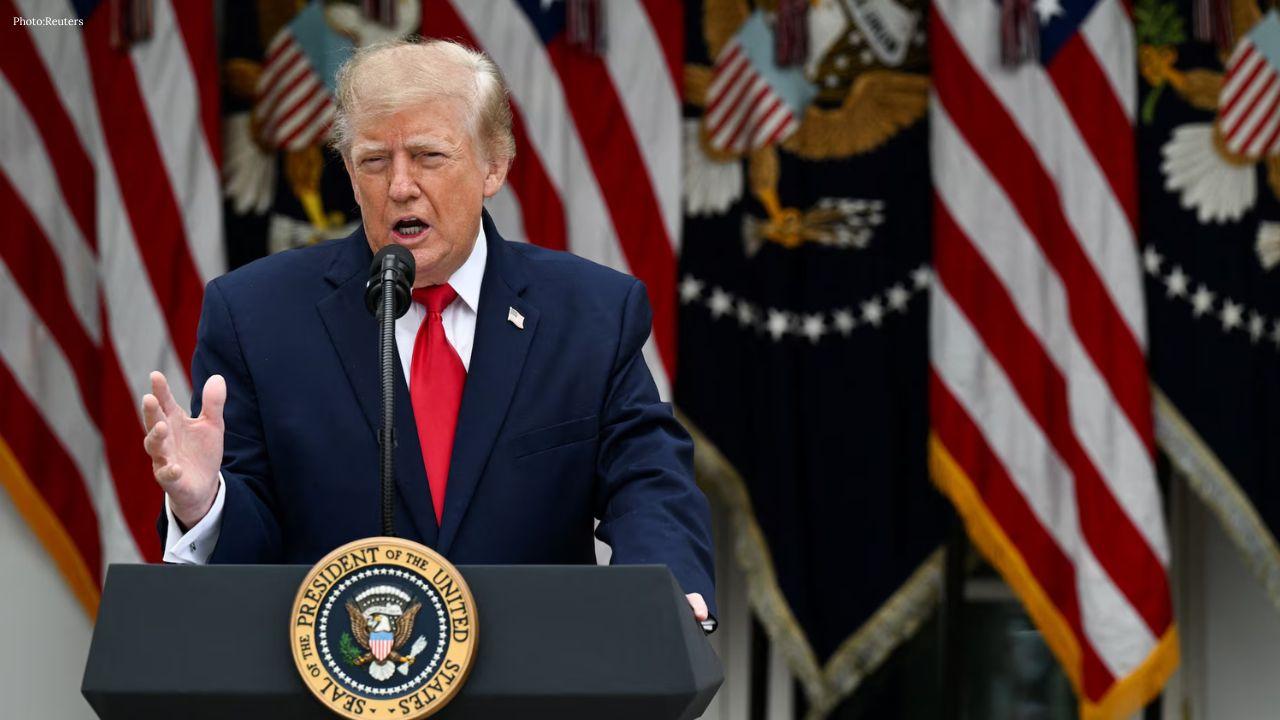
WASHINGTON, October 16, 2026: President Donald Trump has said the United States is holding discussions with Russia and China about denuclearisation, raising renewed attention on international efforts to address the world's nuclear arsenals. His remarks come amid ongoing concerns about strategic stability, nuclear weapons competition and the future of arms control agreements between major powers. Speaking during an interview with Newsmax on Thursday, October 15, Trump said Washington was talking to both Moscow and Beijing about the possibility of reducing nuclear weapons. He described the continued existence of large nuclear stockpiles as a serious concern and expressed his interest in pursuing denuclearisation if it could be achieved. The comments have brought renewed focus to nuclear disarmament, a long-standing international issue involving the reduction or elimination of nuclear weapons. However, Trump's public remarks did not provide a detailed timetable, specific reduction targets or a formal framework for a potential agreement.
The three countries occupy a major position in the global nuclear landscape because of the size and strategic importance of their arsenals. According to the Stockholm International Peace Research Institute (SIPRI), Russia has the world's largest total inventory of nuclear warheads, followed by the United States and China. The United States and Russia also possess the overwhelming majority of the world's nuclear weapons. Their long-standing military rivalry has made bilateral arms control agreements an important part of efforts to manage strategic risks. China's nuclear arsenal has also attracted increasing international attention. During his Newsmax interview, Trump said he expected China to catch up with the United States within the next five years. This was his assessment of China's future capabilities, rather than a confirmed prediction or an official finding. The prospect of involving all three countries in nuclear weapons negotiations is significant because their security policies, military strategies and perceptions of potential threats differ. Any substantial agreement would therefore require decisions on the scope of negotiations, verification arrangements and the responsibilities of each participating country.
During the interview, Trump said he would like to see nuclear weapons eliminated if that were possible. He also stated that the United States was already talking with Russia and China about denuclearisation. Newsmax reported that Trump had spoken with Chinese President Xi Jinping about the issue. However, the available report did not outline the details of those discussions or confirm that the countries had reached an agreement. The distinction between discussions and a formal agreement is important. Statements expressing an interest in disarmament do not, by themselves, establish that governments have accepted specific limits or committed to dismantling nuclear weapons. For negotiations to produce measurable results, the participating countries would need to determine what weapons would be covered, how reductions would be implemented and how compliance would be monitored.
Trump's comments come after the expiration of the New Strategic Arms Reduction Treaty, commonly known as New START, earlier in 2026, according to the report. The treaty was signed by the United States and Russia in 2010. It established limits on certain categories of deployed strategic nuclear weapons and delivery systems and included verification measures designed to improve transparency between the two countries. In 2021, then-US President Joe Biden and Russian President Vladimir Putin agreed to extend the treaty for five years, keeping its limits in place until its expiration in 2026. The end of the agreement has renewed attention on the future of arms control between Washington and Moscow. Without a replacement arrangement, questions remain about what mechanisms could govern future limits on their strategic nuclear forces. Trump's latest remarks suggest that denuclearisation remains a subject of discussion, but they do not confirm that a replacement treaty has been finalised.
China's nuclear capabilities are an important part of the wider debate about future arms control. As its arsenal develops, the United States has increasingly highlighted the need to consider China's role in discussions about strategic weapons. Bringing Beijing into a broader framework could prove complicated because the three countries have different nuclear stockpile sizes, security priorities and approaches to deterrence. Russia and the United States have historically negotiated bilateral limits on strategic nuclear weapons. A wider arrangement would need to account for China's capabilities while addressing concerns raised by each participating government. The challenge is not limited to the number of warheads. Negotiators would also have to consider delivery systems, military readiness, verification, transparency and how each country defines a stable balance of strategic capabilities.
Read Also: Malaysia Economy Grows 5.3% in Q3 as Tech Exports Support Growth
A meaningful nuclear disarmament agreement would require more than a general commitment to reducing weapons. Governments would need to establish clear and verifiable obligations.
Key issues could include:
Defining which nuclear warheads and delivery systems would be covered.
Establishing agreed limits or reduction targets.
Creating verification procedures to assess compliance.
Determining how information would be exchanged between participating countries.
Setting a timetable for implementation and reviewing progress.
Establishing procedures for addressing alleged violations or disagreements.
These are potential elements of a future framework, not confirmed terms of an agreement announced by Trump. Verification would be particularly important because nuclear weapons programmes involve sensitive military information. Governments would need a way to establish confidence that agreed limits were being respected while protecting legitimate national security interests. The involvement of three major nuclear powers could also require a different structure from previous bilateral arrangements.
The United States, Russia and China have significant influence over the international nuclear balance. Discussions aimed at reducing nuclear risks could therefore have implications well beyond their bilateral relationships. If negotiations eventually produce concrete commitments, they could contribute to greater transparency and more predictable limits on certain nuclear capabilities. However, the practical impact would depend on the terms of any agreement, the willingness of the countries to participate and the effectiveness of verification arrangements. The absence of a confirmed framework means it is too early to determine whether the latest discussions will lead to measurable reductions in nuclear arsenals. For now, the central issue is whether the stated conversations can progress from political statements to formal negotiations with clear objectives and enforceable commitments.






Spain's Diego Poncelet Sets Skateboarding World Speed Record
Spain's Diego Poncelet reaches 151.83 km/h in a record-breaking downhill skateboard run in Canada, s

Hyundai Recalls 94,622 US Vehicles Over Potential Fire Risk
Hyundai recalls 94,622 US vehicles over overheating seat motors. Check affected Genesis models, fire

Nvidia Pledges $250 Million for UK AI Safety Research
Nvidia will provide $250 million in computing resources over five years to support AI safety researc

Jacob Bethell Returns as England Name Squads for Australia Tour
England name ODI and T20 squads for the Australia tour, with Jacob Bethell returning from injury and

Beauden Barrett Opens Up About Mental Struggles During All Blacks Exile
Beauden Barrett discusses his confidence struggles after missing six tests, his return against Austr

IMF Says AI Investment Supports Global Growth Despite Energy Shock
IMF says AI investment is supporting global growth near 3%, with Asian economies benefiting from ris

