
You have not yet added any article to your bookmarks!
Join 10k+ people to get notified about new posts, news and tips.
Do not worry we don't spam!
Post by : Rohit Dhiman
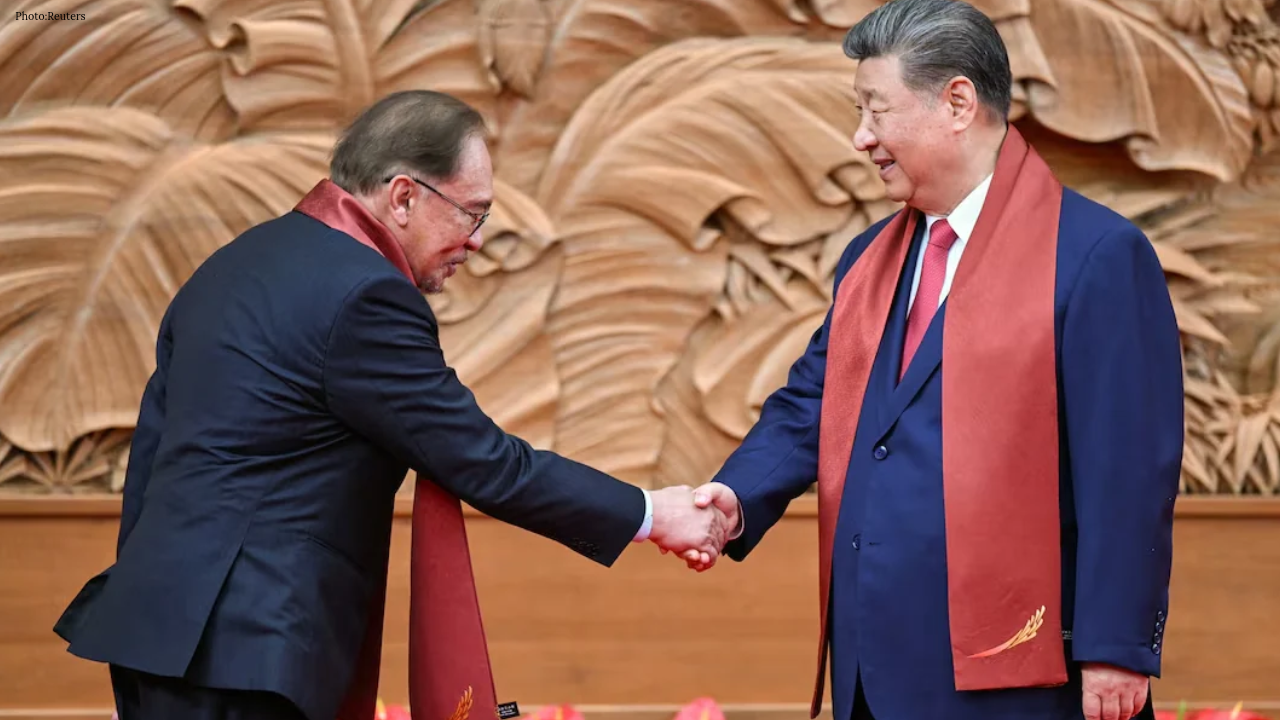
Malaysian Prime Minister Anwar Ibrahim has offered a detailed explanation of how his government is managing relations with two of the world's most influential powers, saying that dealing with China has been comparatively easier than engaging with the United States. His remarks come at a sensitive moment when Washington and Beijing are competing for influence over advanced technology, artificial intelligence, semiconductor production and global investment. In an interview with the South China Morning Post in Shenzhen, Anwar explained that Malaysia's geographical proximity, historical connections and familiarity with Chinese culture have helped make diplomatic engagement with Beijing more straightforward. However, he firmly rejected suggestions that Malaysia is moving closer to China at the expense of its relationship with Washington. The Malaysian leader stressed that maintaining strong ties with Beijing does not prevent his country from cooperating with the United States. According to him, Malaysia wants to preserve independent decision-making and build partnerships based on its economic and national interests rather than becoming part of either superpower's political camp. The remarks have attracted attention because the debate over Malaysia's diplomatic position has intensified following new American restrictions on advanced artificial intelligence chips destined for Malaysia and three other Southeast Asian countries.
Explaining the difference between his interactions with Washington and Beijing, Anwar said that China had never objected to Malaysia maintaining close relations with the United States. He also said that Chinese leaders had not attempted to prevent Malaysia from entering into technology-related arrangements with American companies. Anwar described his meetings with Chinese President Xi Jinping and Premier Li Qiang as relatively accessible and productive. He indicated that Chinese leaders generally take time to listen to Malaysia's concerns and understand the country's position. Geographical proximity is another important factor. Malaysia and China have long-standing regional connections, and their geographical and economic relationship has created greater familiarity between the two countries. Anwar's comments suggest that diplomatic convenience should not automatically be interpreted as political alignment. Although communication with Beijing may be easier, Malaysia still considers its partnership with Washington important. He also highlighted that China had not demanded that Malaysia distance itself from the United States or choose Beijing over Washington.
One of the major issues behind Anwar's comments is the growing disagreement between Washington and Beijing over access to advanced semiconductor technology. The United States recently announced restrictions affecting the supply of advanced artificial intelligence chips to Malaysia and three other Southeast Asian countries. American authorities are concerned that sophisticated computing chips could reach Chinese companies or be used in data centres operated by Chinese businesses in the region. These restrictions could have significant consequences for Malaysia, which has been developing its position as one of Southeast Asia's major destinations for data centre investments. The country has attracted nearly US$100 billion in data centre investments since 2021. This rapid expansion has made Malaysia an increasingly important location for companies looking to build digital infrastructure and expand their artificial intelligence capabilities. However, Washington's latest measures have created uncertainty about how technology companies can continue operating in Malaysia while complying with American export regulations. The situation places the Malaysian government in a difficult position. It must protect its relationship with American technology suppliers while ensuring that Chinese investors and companies can continue participating in the country's growing digital economy.
Malaysia's growing importance in the global technology industry is closely connected to its expanding data centre sector. Several major international companies have established operations or announced substantial investments in the country. These include American technology giants such as Nvidia and Google, alongside significant investments from Chinese-owned data centre operators. Google has announced plans to invest US$15 billion during 2027 and 2028 in Malaysia. The investment programme includes data centres and clean energy projects, among other developments. Such investments are expected to strengthen Malaysia's digital infrastructure and support the increasing demand for cloud computing, artificial intelligence and other technology services. However, restrictions on advanced semiconductor exports could complicate the expansion of this sector. Modern data centres require powerful processors to handle large volumes of information and support advanced computing applications. If access to these components becomes more complicated, companies operating in Malaysia could face additional regulatory requirements and uncertainty about future expansion plans. For Kuala Lumpur, the challenge is to ensure that international investment continues without allowing the country to become a route for technology transfers that violate foreign export regulations.
Anwar also revealed details of a conversation he had with US President Donald Trump during the latter's official visit to Kuala Lumpur in October 2025. The meeting took place during Trump's visit to attend the 47th ASEAN Summit. According to Anwar, the two leaders had a roughly 40-minute conversation inside the American president's official limousine, known as the Beast. During that discussion, Trump reportedly told Anwar that Malaysia appeared to be leaning towards China. Anwar said he responded by explaining that Malaysia did not need to choose sides because China was its immediate neighbour. He highlighted the countries' shared regional interests, geographical proximity and long-standing historical connections. He also reminded Trump that Malaysia maintained close economic relations with the United States, including bilateral trade and American business investments. Anwar further referred to his personal connection with the United States, mentioning his previous teaching experience at Georgetown University. Describing the interaction, Anwar indicated that Trump listened carefully during their conversation. Although he was unsure whether the American president fully agreed with his explanation, he characterised the discussion as friendly and respectful. The exchange highlights how Malaysia's relationship with China has become an important subject in its diplomatic discussions with Washington.
Despite describing China as easier to deal with, Anwar has repeatedly maintained that Malaysia does not intend to align itself exclusively with either country.His government's approach is based on maintaining working relationships with both global powers while protecting Malaysia's independence in foreign policy decisions. This position is particularly important because China and the United States play different but equally significant roles in Malaysia's economy. China remains Malaysia's largest trading partner, while the United States is also a major economic partner and an important source of technology investment. According to the figures cited in the interview, Singapore is ahead of mainland China and Hong Kong as a source of annual foreign investment in Malaysia, with China and Hong Kong occupying the second and third positions respectively. In terms of trade, China ranks first, while the United States comes third behind Singapore. These economic connections make it difficult for Malaysia to take a position that could damage its commercial relationships with either side. For Anwar, the objective is to maintain access to international markets, attract investment and cooperate with different technology partners without accepting unnecessary political pressure.
Read Also: Car Bomb Explosion Near Colombia Governor's Office Injures 12
Malaysia's approach to international technology cooperation also reflects its attempt to maintain flexibility. The country is among seven ASEAN members that have joined the World Artificial Intelligence Cooperation Organisation (WAICO), an artificial intelligence governance alliance led by China. At the same time, Malaysia has agreed to establish a sovereign AI cloud with the United States. This arrangement reflects its willingness to work with American technology partners even while participating in China's AI-related initiatives. However, Malaysia has not joined Pax Silica, a US-led initiative designed to strengthen supply chains for artificial intelligence, semiconductors and critical minerals while reducing dependence on China. Singapore and the Philippines are among the ASEAN countries participating in the initiative. When asked about the possibility of joining Pax Silica, Anwar indicated that Malaysia remained open to the idea. He also said he did not expect Beijing to object to such a decision. According to Anwar, China has never pressured Malaysia to avoid American-led technology initiatives. He said his discussions with Xi Jinping had not given him any indication that Beijing wanted Kuala Lumpur to distance itself from Washington. This is an important part of Malaysia's diplomatic strategy because participation in different international technology partnerships could help the country attract investment and strengthen its position in the global semiconductor and AI industries.
Addressing concerns that closer cooperation with the United States could create problems with Beijing, Anwar offered a direct explanation. He said China had never suggested that Malaysia should be cautious about working with the Americans or avoid participating in US-led programmes. His comments specifically referred to Pax Silica and Malaysia's broader technology cooperation with Washington. Anwar's position suggests that Kuala Lumpur believes it should be able to make independent decisions about international partnerships without seeking permission from either superpower. The Malaysian government is interested in technology, investment and economic opportunities from both countries. It does not want its relationship with one partner to become an obstacle to cooperation with another. This approach is especially important as global supply chains become increasingly influenced by geopolitical competition. For Malaysia, remaining connected to different technology ecosystems could provide economic advantages, provided the country can manage regulatory requirements and international expectations.
Anwar also addressed the practical implications of the new American restrictions on advanced AI chips. He indicated that Malaysia would monitor whether American companies operating in the country were complying with their contractual and regulatory obligations, particularly restrictions preventing the export of certain chips to China. He said Malaysia would respect conditions imposed by the United States on its own companies. However, Anwar made an important distinction between enforcing American export restrictions and independently deciding which foreign companies Malaysia should allow to invest in its economy. He maintained that compliance with US regulations would not automatically prevent Malaysia from continuing to cooperate with Chinese investors and businesses. The government intends to allow companies to make their commercial decisions within the applicable laws and regulatory framework. Anwar also said he had communicated this position to Donald Trump and US Secretary of State Marco Rubio approximately two weeks before the interview. This suggests that the issue has already been part of Malaysia's recent diplomatic engagement with senior American officials.
Anwar also delivered a clear message to foreign investors seeking special government assistance to protect their supply chains. He indicated that if an international company wanted Malaysia to provide dedicated government supervision or additional support to safeguard its supply chain, the company would also have to bear the associated costs. The prime minister made it clear that government assistance should not become an expense that Malaysian taxpayers are automatically expected to cover for private businesses. His position reflects an increasingly commercially driven approach to attracting international investment. Malaysia remains interested in welcoming major technology companies, but the government also wants investors to recognise the financial and administrative responsibilities associated with their operations. This could become particularly relevant as international companies face more complicated compliance requirements because of restrictions involving sensitive technologies.
The comments from Malaysia Prime Minister Anwar Ibrahim highlight a broader challenge facing countries that maintain strong economic relationships with both China and the United States. The competition between the two powers is no longer limited to traditional trade or diplomatic influence. It increasingly involves artificial intelligence, semiconductor manufacturing, advanced computing infrastructure, critical minerals and control over global technology supply chains. Malaysia occupies an important position in this changing environment because it is attracting investments from companies connected to both economies. Its growing data centre industry, international technology partnerships and strong trade links make it an important destination for global businesses. However, stricter American export controls could increase pressure on Malaysia to demonstrate that sensitive technology is being used in accordance with international regulations. At the same time, distancing itself from Chinese investors could affect another major source of economic activity. Anwar's remarks therefore underline Malaysia's determination to avoid being forced into a choice between Washington and Beijing. For now, Kuala Lumpur appears focused on maintaining diplomatic flexibility, attracting investment from different countries and ensuring that decisions about its economic future remain under Malaysian control. The coming months will show how effectively Malaysia can maintain this balance as competition over artificial intelligence and semiconductor technology continues to intensify.






Shubman Gill Wants Bowler-Friendly Pitch for 2nd Test
Shubman Gill wants a bowler-friendly Christchurch pitch as India prepare to bounce back after a draw

Cadillac Targets F1 Progress After Difficult Debut Season
Cadillac F1 retains Valtteri Bottas for 2027 as Dan Towriss focuses on team stability, performance a

GTA 6 Launches Worldwide After 13 Years With a New Vice City Story
GTA 6 arrives after 13 years with Jason and Lucia, a new Vice City world, immersive gameplay, major

Arda Guler Signs Six-Year Real Madrid Contract Extension Until 2032
Arda Guler signs a new six-year Real Madrid deal, extending his stay until 2032 after an impressive
APEC Members Emphasise Safe and Responsible Use of Artificial Intelligence
APEC members discuss responsible AI use, digital innovation and data governance as China and the US

Union of European Clubs Challenge UEFA and EFC Over EU Competition Rules
UEC files an EU competition complaint against UEFA and EFC, challenging club representation, governa