You have not yet added any article to your bookmarks!
Join 10k+ people to get notified about new posts, news and tips.
Do not worry we don't spam!
Post by : Rameen Ariff
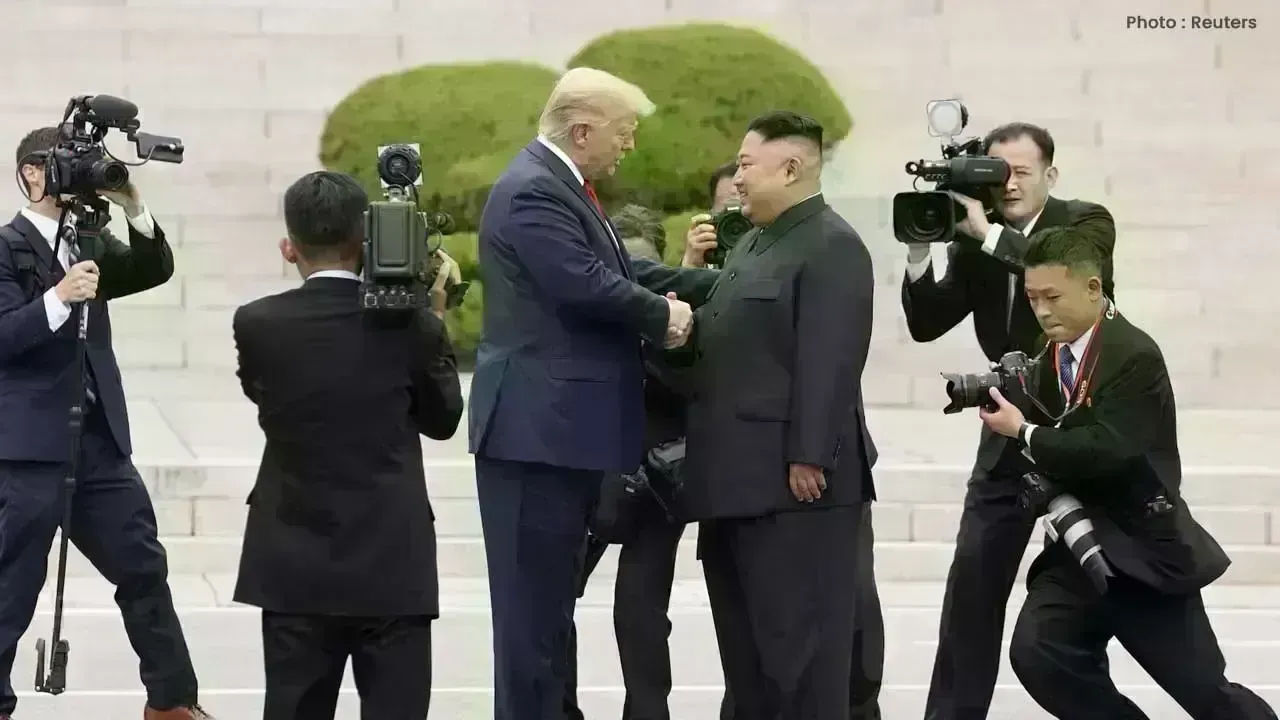
U.S. President Donald Trump’s newly released global security strategy has notably removed any mention of denuclearising North Korea, sparking speculation about a possible shift in Washington’s approach toward Pyongyang in 2026. The omission marks a significant departure from decades of U.S. policy, as every National Security Strategy since the early 2000s has included ending North Korea’s nuclear threat as a key objective.
The absence of this goal in Friday’s document has raised questions among analysts and international observers about the United States’ future policy in Northeast Asia. Experts suggest that the move could be designed to create diplomatic space for engagement with North Korea, potentially paving the way for talks or negotiations in the coming year.
North Korea’s nuclear programme, which began drawing global attention in the early 2000s, has long been a central focus of U.S. national security policy. Past administrations have emphasised denuclearisation as a top priority, often tying it to sanctions, military deterrence, and multilateral negotiations involving regional partners.
By leaving denuclearisation off the new roadmap, Trump’s administration appears to be signalling a more flexible approach toward Pyongyang, possibly prioritising regional stability, security cooperation, or economic engagement over a strict nuclear elimination agenda. Observers note that this strategy could alter diplomatic dynamics in East Asia, influencing both U.S.-South Korea and U.S.-Japan relations as well as interactions with China.
While the decision has sparked debate, it remains unclear how Pyongyang will respond or whether North Korea’s leadership will interpret the omission as an invitation for renewed dialogue. Some analysts warn that without a clear denuclearisation target, U.S. leverage over North Korea could weaken, potentially complicating efforts to contain the nuclear threat in the region.
The new security roadmap underscores a potential recalibration of U.S. priorities on the global stage, reflecting both domestic political calculations and evolving strategic interests in Asia. How this will impact the long-standing goal of a denuclearised Korean Peninsula remains to be seen, but Washington’s approach signals a notable shift in tone and policy direction.







Josh Kerr and Jakob Ingebrigtsen Set for 1,500m Rivalry Rematch
Josh Kerr and Jakob Ingebrigtsen will renew their 1,500m rivalry at the Ultimate Championship in Bud

PSG Coach Luis Enrique Urges Players to Step Outside Comfort Zone
PSG coach Luis Enrique says players must leave their comfort zone and keep improving as the club tar

China’s Tiangong Sets New 400m Record at Robot Olympics
China’s Tiangong robot sets a new 400m record at the Robot Olympics, beating a South African robot i

George Russell Wins Dutch GP Sprint, Boosts Mercedes Morale
George Russell wins the Dutch GP Sprint from pole as Mercedes teammate Kimi Antonelli extends his F1

Australia 50/3 After Bangladesh Bowled Out for 64 in Second Test
Australia reached 50/3 after Bangladesh were bowled out for 64 in the second Test, with Mitchell Sta

Jordan Burroughs Returns to Wrestling with 2028 Olympic Dream
Jordan Burroughs returns to wrestling with Real American Freestyle as the Olympic champion eyes a po