
You have not yet added any article to your bookmarks!
Join 10k+ people to get notified about new posts, news and tips.
Do not worry we don't spam!
Post by : Anis Farhan
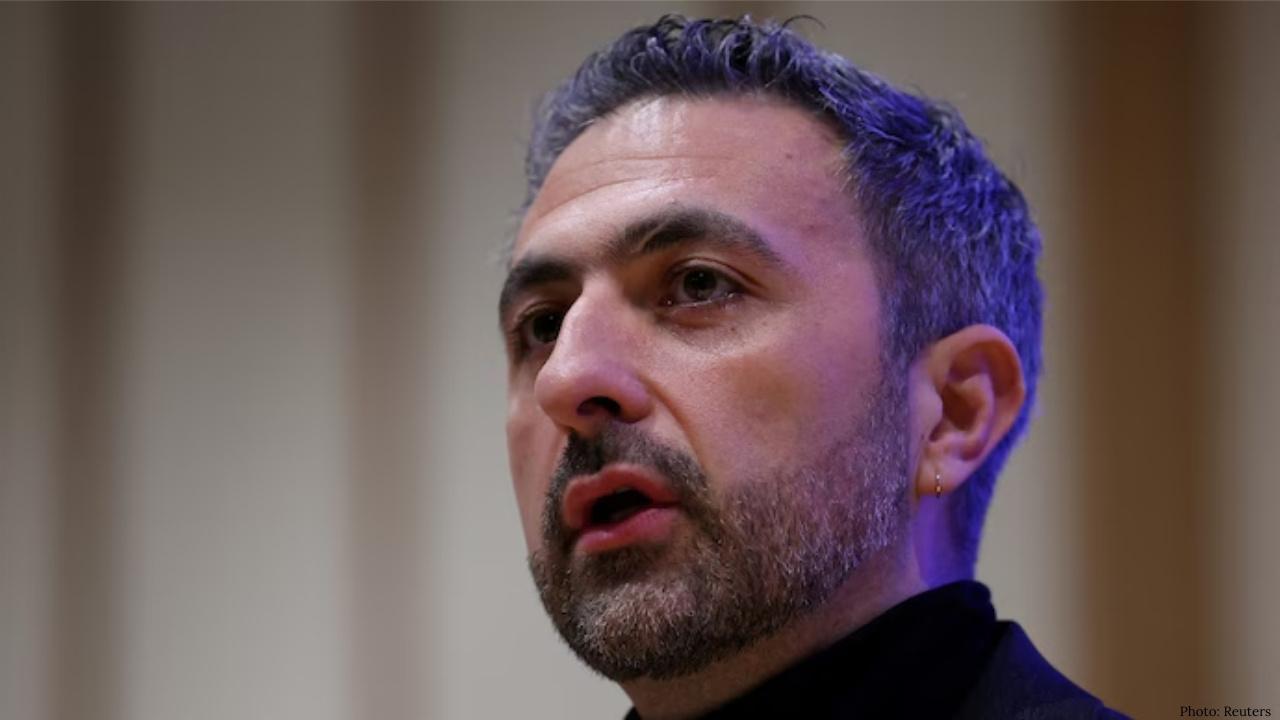
In a consequential interview that has reverberated across global business and technology circles, Mustafa Suleyman, the chief executive of Microsoft AI, has warned that artificial intelligence is on course to automate the vast majority of white-collar jobs within the next year to year and a half. Suleyman’s predictions underscore the rapid evolution of AI systems — particularly professional-grade artificial general intelligence (AGI) and task-specific models — and foreshadow major changes to how work is conducted in office environments worldwide.
His comments come amid a broader context of accelerating AI adoption in corporate settings and growing scrutiny of how emerging technologies are transforming employment, corporate strategy, and workforce structures. This article explores Suleyman’s assertions, the underlying trends driving them, the sectors most exposed to automation risk, and the broader implications for workers, employers and policymakers.
Suleyman — previously known for his role co-founding DeepMind and now heading Microsoft’s AI division — stated in an interview with the Financial Times that routine and knowledge-based tasks commonly executed by office professionals are likely to be fully automated by artificial intelligence within the next 12 to 18 months. He specifically referenced jobs that generally involve working on computers, such as lawyers, accountants, marketing professionals and project managers, emphasising that AI’s capabilities are rapidly approaching “human-level performance” on tasks historically viewed as requiring specialised expertise.
Suleyman’s comments have drawn attention not just because of their timing, but because of his executive position at one of the world’s leading technology companies — positioning him not as a distant futurist, but as an actor at the forefront of AI development and deployment.
AI systems — particularly large language models and task-oriented automation tools — have seen dramatic improvements in recent years. These systems are increasingly capable of completing tasks that were once considered exclusively within the domain of trained professionals, including:
Drafting and reviewing legal documents
Analysing financial data and preparing reports
Automating marketing campaign optimisation
Generating software code and debugging
Suleyman noted that in fields such as software engineering, AI tools are already being used by professionals for the majority of coding tasks, shifting the role of human workers toward higher-level or strategic work while AI handles routine labour.
This dynamic — where AI shifts from an assistive technology to a primary executor of core job functions — underpins Suleyman’s prediction of rapid automation.
Suleyman suggested that the threat of automation is not confined to a niche subset of jobs, but spans a wide range of white-collar professions, including:
Law and legal research
Accounting and financial analysis
Marketing and campaign planning
Project and operations management
Customer service and support coordination
The common strand across these roles is their reliance on cognitive tasks performed at a computer, many of which can be learned by AI through pattern recognition, language understanding and decision-making capabilities.
This does not imply that all jobs will disappear entirely — rather, the routine components of these roles are increasingly tractable for automation, potentially reducing the need for traditional full-time human labour in many cases.
Major corporations are already integrating AI into core workflows. Many organisations use automated systems for:
Document generation and contract analysis
Automated data analytics and forecasting
AI-assisted coding and software optimization
Automated customer response and support systems
These trends illustrate how automation is migrating from peripheral functions into the heart of business processes — a transition that supports Suleyman’s timeline for broader displacement of conventional tasks.
Across the technology industry, companies are increasingly pivoting roles toward strategic oversight, human-AI collaboration, and creative or interpersonal tasks that remain resistant to full automation.
Suleyman’s remarks also reflected Microsoft’s strategic ambition to deliver what he described as professional-grade artificial general intelligence (AGI) — systems capable of performing a broad spectrum of work tasks with a level of versatility traditionally associated with human cognition.
He highlighted that as AI models improve, they will become easier to create — akin to how individuals can now easily create digital content like blogs or podcasts. This democratisation of AI creation suggests a future where custom AI models tailored to specific business needs become commonplace.
If Suleyman’s predictions hold true, the coming months and years could see significant disruption in labour markets. Economists refer to this phenomenon as technological unemployment — displacement of human labour due to innovation and automation — a concept with deep historical roots and contemporary relevance as machines increasingly perform cognitive work previously reserved for humans.
This shift raises urgent questions for policymakers, employers and educators alike:
How will workers transition into new roles?
What social safety nets are needed for displaced workers?
How can education systems prepare future generations for an AI-centric labour market?
Countries and industries will face pressure to rethink workforce development, reskilling programmes, and labour laws that have not previously encountered such rapid automation.
Suleyman is not alone in raising these concerns. Other leaders in the AI space, including researchers and executives, have warned of significant labour market changes as AI becomes more capable and widespread. Some forecasts suggest that many knowledge-based tasks could be significantly affected over similar time horizons.
However, there remain voices urging caution against overestimating automation timelines or assuming uniform displacement. Many analysts argue that human creativity, interpersonal skills, and complex problem-solving will continue to be valuable even as AI handles routine work.
As AI’s footprint expands, workers and organisations may find that success hinges on active adaptation. Professionals who develop skills in AI literacy, human-AI collaboration, and strategic decision-making may thrive alongside evolving technologies. Emphasising lifelong learning and flexible skill development could be central to maintaining relevance in the AI era.
Governments and industry leaders may need to work together to ensure that labour transitions are equitable and that workers are not left behind in the push toward automation. This might include reimagining education, strengthening labour protections, and fostering economic environments conducive to new forms of work.
The prediction by Mustafa Suleyman, chief executive of Microsoft AI, that most tasks in white-collar jobs could be automated within 12 to 18 months challenges conventional expectations about the pace of technological change and its impact on employment. Whether this timeline proves exact or proves slightly longer, the trend toward automation and AI-enhanced work structures appears poised to reshape global labour markets.
With profound implications for workers, employers, policymakers and educators, this moment may mark a critical inflection point in the trajectory of work, productivity and economic organisation — one that will require thoughtful adaptation and strategic foresight across sectors.
Disclaimer: This article is based on expert commentary, projections and available trends at the time of writing. Technology adoption and labour market outcomes may evolve in unpredictable ways, and readers should consider multiple sources and analyses when assessing future impacts.










PM Modi Pays Tribute to Mahatma Gandhi, Urges People to Support Khadi
PM Modi pays tribute to Mahatma Gandhi on Gandhi Jayanti and urges citizens to support Khadi and the

Amazon Seeks to Offload $8 Billion in Nvidia Chips to Investors
Amazon plans to move $8 billion in Nvidia chips to investors, using a new financing model to strengt

Samsung Raises Galaxy S26 Prices as Memory Chip Costs Rise
Samsung raises Galaxy S26 prices in South Korea as rising memory chip costs put pressure on smartpho

Lewis Hamilton Calls Singapore Grand Prix One of F1's Toughest Races
Lewis Hamilton discusses the demanding Singapore Grand Prix and brings Plus44 and Almave to Singapor

Denmark's Pandora Opens World's Largest Jewellery Factory in Vietnam
Pandora opens its largest jewellery factory in Vietnam, expanding global production, strengthening s

Gautam Gambhir Questions Batting-Friendly Pitches After India's Record ODI Chase
Gautam Gambhir questions batting-friendly ODI pitches after India’s record chase, calling for a bett

