
You have not yet added any article to your bookmarks!
Join 10k+ people to get notified about new posts, news and tips.
Do not worry we don't spam!
Post by : Anis Farhan
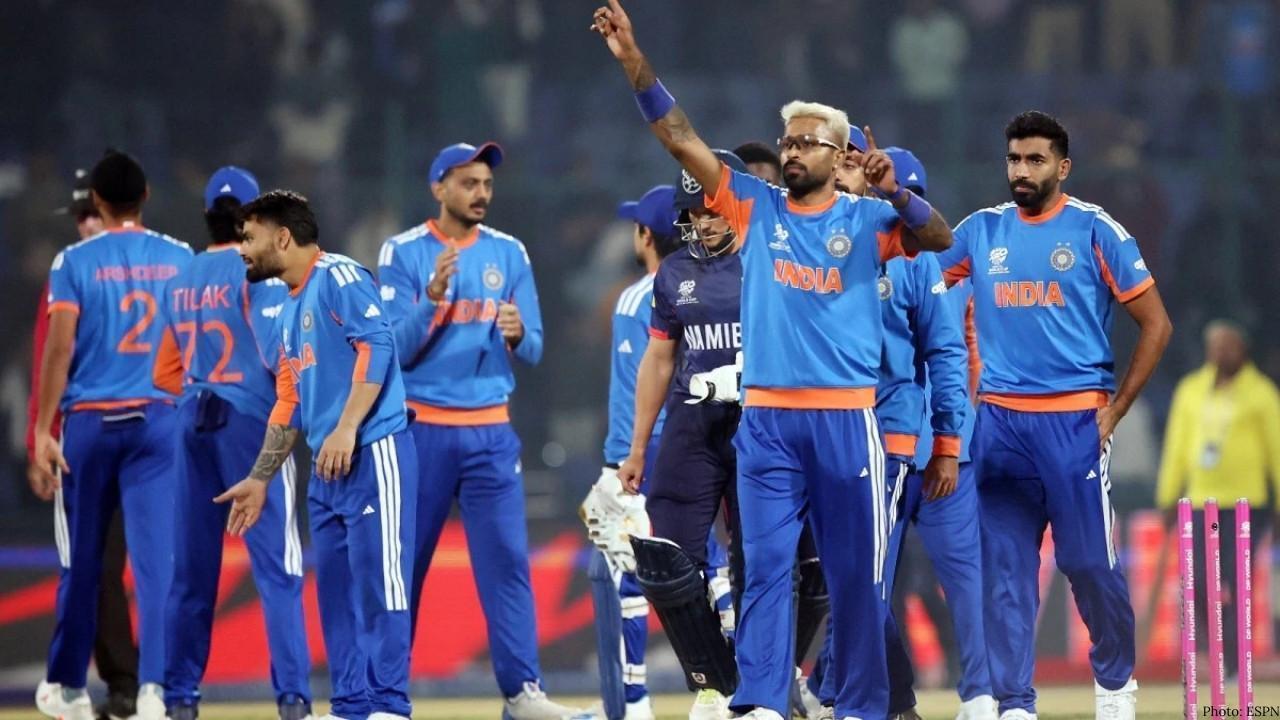
India’s T20 World Cup 2026 campaign witnessed a significant performance on Thursday as the hosts dominated Namibia in Group A at the Arun Jaitley Stadium in Delhi. While the outcome—an overwhelming 93-run victory—seemed emphatic on paper, it also exposed some persistent concerns about India’s batting strategy during the middle overs, particularly on a pitch that offered assistance to bowlers.
India’s win reinforced their position at the top of Group A, boosting confidence ahead of high-stakes matches in the Super Eight round, especially their looming clash with Pakistan in Colombo. Yet, even in this commanding performance, tactical inefficiencies highlighted a critical area India must address to remain contenders for the trophy.
This article delves into the nuances of that match, offering insights into India’s batting dynamics, the conditions at play, notable performances, and the broader implications of their middle-overs struggle as they navigate the tournament’s pressure cooker stage.
India set a formidable target of 209/9 batting first, powered by impactful contributions from key batters. Despite losing early momentum at various points, they managed to put up a total that was always going to be challenging for a disciplined Namibia side.
In return, India’s bowlers executed a well-planned attack, skittling Namibia for 116 runs in just 18.2 overs, showcasing clinical bowling and fielding efforts that underscored the team’s dominance.
However, this statistical triumph masked subtleties that merit deeper analysis—especially regarding how Indian batters handled the middle overs in conditions that were slower and more difficult than expected.
The match was played on a surface that did not offer the typical true bounce or pace expected of Delhi pitches. Instead, it was slow, low, and occasionally unpredictable—conditions that made stroke play difficult once the initial burst of runs subsided.
Slower tracks often invite tactical bowling, where patience, accuracy, and subtle variations can stymie batters who fail to adapt quickly. In this case, India’s batting lineup encountered that exact scenario. The pitch rewarded disciplined bowling and challenged hitters who relied on timing and rhythm more than raw power.
India’s top order made promising strides early on, with selectors eyeing aggressive starts. A quick first 10 overs set a positive platform, with batters adapting well to the early pace of the bowlers and often finding scoring opportunities.
However, the tempo began to shift as the innings progressed into the crucial middle overs (overs 7–15), traditionally reserved for consolidation and building toward a late-innings onslaught. On this pitch and against disciplined bowling, India’s strategy faltered.
During the middle phase, India’s scoring rate dipped, and wickets were lost with regularity. Batters struggled to find clear scoring avenues on the sluggish surface, leading to stagnation and unnecessary pressure.
Namibia’s bowlers, although less experienced on paper, executed smart lengths and variations that encouraged defensive play from India’s hitters. The result was a middle-overs segment that looked more cautious than calculated—a phase where Indian batters seemed content to play out deliveries rather than force momentum.
This exposed a tactical dilemma: against high-caliber bowling attacks in later stages of the tournament, India cannot afford such periods of stagnation without risking losing the initiative.
Among India’s batting contingent, Hardik Pandya exemplified combative intent. His innings—marked by aggressive striking and intelligent shot selection—reminded critics of his value as a finisher and middle-order power hitter.
Pandya capitalized on loose deliveries and took calculated risks that yielded significant momentum shifts, proving crucial in lifting India past challenging phases.
While the top order set an aggressive tempo and the finishers added vital runs, the middle overs lacked the punch and creativity required to string together meaningful partnerships with pace. This phase saw India’s batters frequently pinned down by tight bowling, which invited tactical uncertainty.
India’s bowling unit delivered a disciplined and cohesive performance. Even though conditions favored batters earlier, the bowlers adapted quickly, exploiting the sluggish surface with subtle seam movement and variations in pace.
India’s frontline bowlers demonstrated control, with disciplined line and length that prevented Namibia from gaining momentum. They combined strategic placements with variations that tested even the lower-order batters, ultimately leading to a comprehensive bowling display.
While India’s batting lineup has depth and firepower, the middle overs on slower tracks demand a combination of patience and intent. Rather than retreating into defensive play, batters must balance caution with proactive scoring to prevent pressure creep—a lesson highlighted in this match.
Future matchups, especially against quality spin and disciplined pace attacks, will test India’s ability to navigate these phases.
Effective middle-overs batting requires a blend of aggression and nuanced control. India’s strategy may need refinement to ensure that players aren’t merely reacting to conditions but proactively shaping innings with adaptability and tactical awareness.
India’s commanding performance against Namibia may cloak deeper tactical lessons that only surface under pressure. While the win bolstered confidence and improved net run rate prospects, the team must heed the tactical warnings from this match to avoid pitfalls against stronger opponents, especially in matches to come in the Super Eight stage.
As the tournament progresses, India’s adaptability—especially in managing middle overs on slower pitches—will be a defining factor in their quest for World Cup glory.
Disclaimer: This article is based on reporting from available match coverage at the time of writing. Performance analysis reflects observed match dynamics and strategic patterns relevant to ongoing tournament progression. Viewer discretion advised for tactical interpretations.










PM Modi Pays Tribute to Mahatma Gandhi, Urges People to Support Khadi
PM Modi pays tribute to Mahatma Gandhi on Gandhi Jayanti and urges citizens to support Khadi and the

Amazon Seeks to Offload $8 Billion in Nvidia Chips to Investors
Amazon plans to move $8 billion in Nvidia chips to investors, using a new financing model to strengt

Samsung Raises Galaxy S26 Prices as Memory Chip Costs Rise
Samsung raises Galaxy S26 prices in South Korea as rising memory chip costs put pressure on smartpho

Lewis Hamilton Calls Singapore Grand Prix One of F1's Toughest Races
Lewis Hamilton discusses the demanding Singapore Grand Prix and brings Plus44 and Almave to Singapor

Denmark's Pandora Opens World's Largest Jewellery Factory in Vietnam
Pandora opens its largest jewellery factory in Vietnam, expanding global production, strengthening s

Gautam Gambhir Questions Batting-Friendly Pitches After India's Record ODI Chase
Gautam Gambhir questions batting-friendly ODI pitches after India’s record chase, calling for a bett

