You have not yet added any article to your bookmarks!
Join 10k+ people to get notified about new posts, news and tips.
Do not worry we don't spam!
Post by : Jyoti Gupta
Photo:Reuters
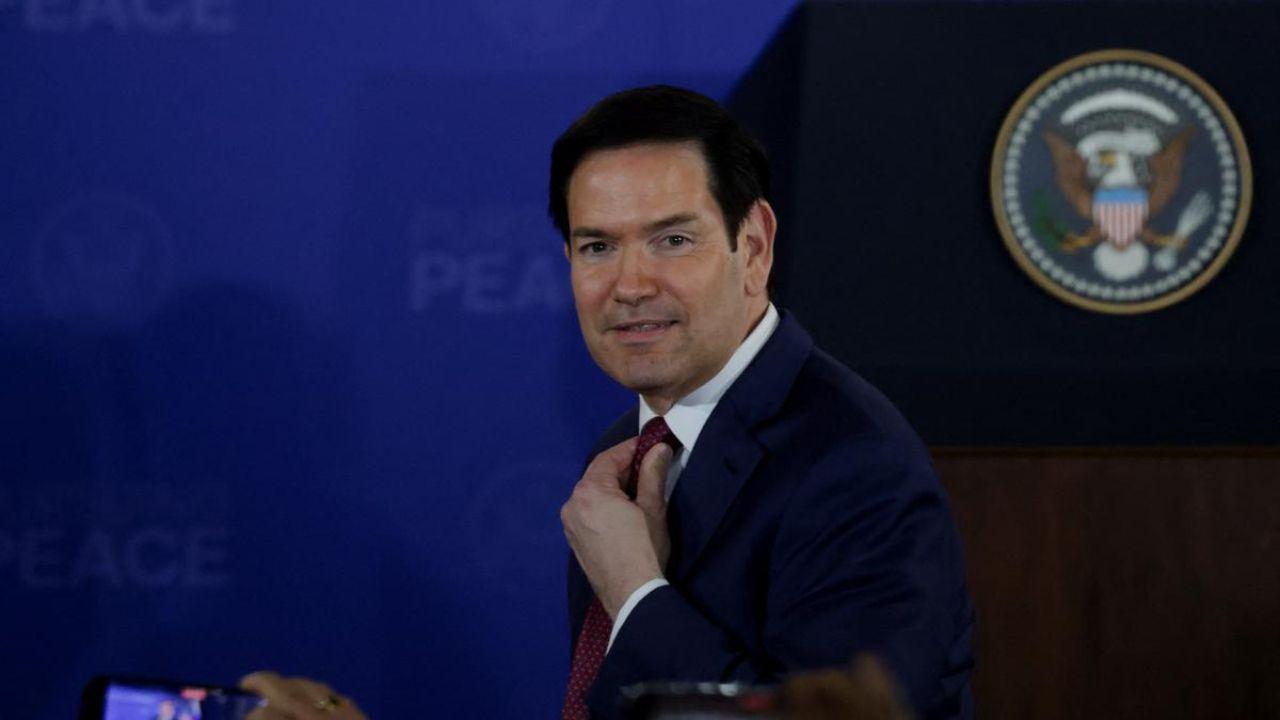
The United States has once again placed the spotlight on South Asia, with its top diplomat saying Washington is closely watching the delicate situation between India and Pakistan. Secretary of State Marco Rubio said that ceasefires in conflict regions can collapse quickly, which is why the U.S. keeps a daily watch on the tense relationship between the two nuclear-armed neighbors.
Rubio explained that a ceasefire can only work if both sides agree to stop fighting, and maintaining such agreements is always difficult. “We keep an eye every single day on what’s happening between Pakistan and India, as well as other regions like Cambodia and Thailand,” he remarked. He warned that peace arrangements are fragile and can break down overnight, stressing that the ultimate goal should not be just a temporary halt to fighting, but a long-lasting peace that prevents future wars.
Trump’s Claim of Stopping War
In his comments, Rubio highlighted the role of President Donald Trump, saying the U.S. leader helped prevent a war between India and Pakistan. According to him, Trump made peace a top priority of his foreign policy and intervened in multiple global conflicts. “We are blessed to have a president who puts peace first. We have seen results in Cambodia and Thailand, in Rwanda and the DRC, and in South Asia where India and Pakistan stepped back from a dangerous conflict,” Rubio said in another interview.
Trump himself has been repeating the claim that he personally settled tensions between India and Pakistan. On May 10, he announced on social media that the two countries had agreed to a “full and immediate” ceasefire after long hours of talks mediated by Washington. Since then, he has mentioned this achievement dozens of times, saying he used the influence of the United States to push both sides toward peace.
The former businessman-turned-president has argued that without his intervention, the situation could have spiraled into something much worse. He recalled incidents where both nations shot down each other’s fighter jets and suggested the conflict was heading toward possible nuclear confrontation. Trump insists he was able to stop the escalation, emphasizing that lives were saved and stability was restored.
India’s Response
However, India has strongly rejected the idea that Washington or any other foreign country had a role in bringing about a ceasefire. Prime Minister Narendra Modi has made it clear in Parliament that no international leader pressured India to halt its operations. External Affairs Minister Subrahmanyam Jaishankar has also stated firmly that the suspension of India’s military action, known as Operation Sindoor, was entirely a domestic decision. He added that there was no connection between the ceasefire and any promises of future trade deals, as Trump had claimed.
According to New Delhi, the choice to pause the military operation was guided by India’s own assessment of the situation, not outside influence. Officials have stressed that India does not allow third-party intervention in its conflicts with Pakistan, keeping with its long-standing policy of handling bilateral disputes directly.
Trump Repeats Claim at Putin Summit
Even during his high-profile meeting with Russian President Vladimir Putin on August 15, Trump once again highlighted his role in the India-Pakistan ceasefire. Speaking about his record of preventing wars, he said, “Look at India and Pakistan. They were shooting down airplanes, and it could have gone nuclear. I was able to stop it. Wars are very bad, and if you can avoid them, you should.” He credited his leadership and America’s influence for making peace possible.
Trump has used this claim repeatedly in recent months, presenting it as evidence of his ability to resolve international conflicts. He often frames his interventions as proof of American power to bring rivals to the negotiating table, while also hinting that peace is linked with opportunities for trade and economic cooperation.
Larger Context of U.S. Watchfulness
Rubio’s comments and Trump’s repeated statements show how closely the United States is linking its global role with crisis management in Asia and beyond. By publicly associating Washington with peace in volatile regions, U.S. officials are signaling that America remains deeply engaged in global diplomacy.
For India and Pakistan, however, the story remains more complicated. While Washington speaks about its influence, New Delhi insists that the decisions around Operation Sindoor were entirely its own. Pakistan, meanwhile, has remained largely silent about Trump’s claim, neither confirming nor denying the details.
The broader message is clear: while the U.S. sees itself as a peace broker, India sticks to its policy of strategic independence, rejecting third-party mediation. This difference in narratives has now become part of the larger debate about how international diplomacy interacts with South Asian conflicts.
Why It Matters
The India-Pakistan relationship has always been one of the most sensitive flashpoints in the world, given both nations’ history of wars, their unresolved disputes, and their nuclear weapons. Any sign of escalation immediately draws attention from global powers. For the United States, preventing conflict in South Asia is important not just for regional peace, but also for global security.
Rubio’s remarks show that Washington remains on alert and sees South Asia as an area where tensions must be monitored daily. Trump’s repeated assertions add another layer, as he seeks to claim credit for preventing what he describes as a possible nuclear disaster.
The situation highlights both the fragility of peace agreements and the politics surrounding them. On one hand, the U.S. presents itself as a peace-maker, with Trump and Rubio stressing America’s role in averting war. On the other hand, India insists on sovereignty and independence in handling its conflicts, dismissing foreign claims of involvement.
Whether Trump’s claims are accurate or exaggerated, the focus remains on the fact that India and Pakistan stepped back from open confrontation. For now, the ceasefire holds, but as Rubio warned, such arrangements are always fragile and require constant attention.




Japan Wildfire Forces Mass Evacuation in Iwate
Massive forest fire in Iwate spreads fast, forcing evacuation of over 1,000 residents as teams battl

Malaysia Cup Final Ticket Prices Stay Same
MFL keeps ticket prices unchanged for JDT vs Kuching City final despite rising costs, ensuring affor
China's Subtle Shift in Iran Conflict Diplomacy
As global tensions rise, China quietly enhances its role in Iran diplomacy, emphasizing stable energ

Kuwait Continues Remote Learning, Exams Online
Kuwait keeps remote learning and online exams, while coast guard allows daytime sailing and authorit

Bhutan-India Car Smuggling Probe Intensifies
Bhutan customs team in Kerala to probe cross-border vehicle smuggling under Operation Numkhor, invol
Nepal Protests Erupt Over Border Customs Rule
Strict customs enforcement on India goods sparks protests in Nepal, raising prices and disrupting da