You have not yet added any article to your bookmarks!
Join 10k+ people to get notified about new posts, news and tips.
Do not worry we don't spam!
Post by : Rameen Ariff
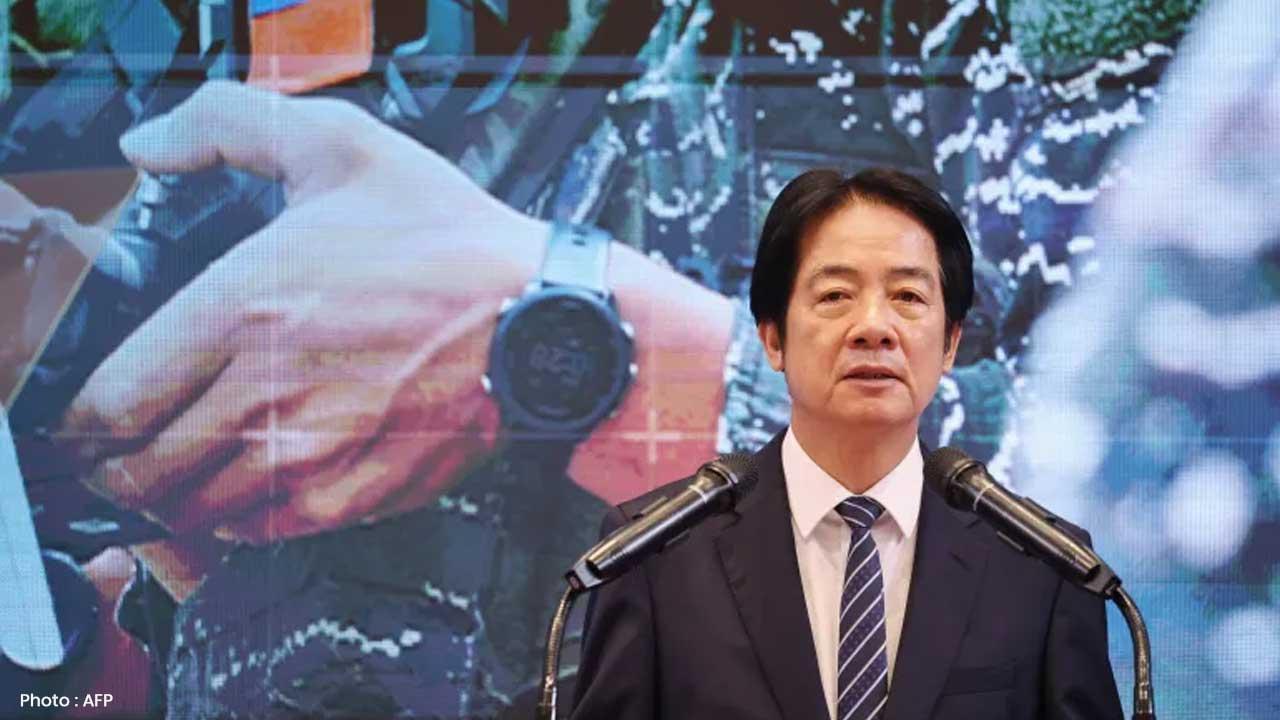
Taipei, Taiwan – On November 26, 2025, Taiwan’s President William Lai Ching-te announced a major new defense budget plan, aiming to spend $40 billion over the next eight years. This budget is part of a larger effort to strengthen Taiwan’s military and protect the island from possible threats, especially from China.
President Lai revealed the plan during a news conference in Taipei. He said the goal is to build an “unassailable Taiwan” by focusing on advanced technology and innovation in defense. Taiwan wants to improve its joint combat readiness by 2027, as experts have suggested this could be when China might consider military action against the island.
The new $40 billion budget is a significant increase from previous defense spending and will help Taiwan buy new weapons and military equipment, mainly from the United States. It will also support Taiwan’s ability to conduct asymmetrical warfare, which means using smart strategies and smaller forces to defend against a stronger enemy.
This announcement comes amid rising tensions in the region. Recently, Japan and China have had a diplomatic disagreement after the Japanese Prime Minister mentioned that Japan could intervene if Taiwan was attacked. China claims Taiwan as its own territory and has repeatedly threatened to take control by force if necessary.
The United States has supported Taiwan’s defense efforts. Raymond Greene, the top US envoy to Taiwan, welcomed the new budget plan and urged Taiwan’s political parties to work together to strengthen the island’s defenses.
President Lai’s plan includes raising Taiwan’s defense spending to over 3% of its Gross Domestic Product (GDP) next year and aiming for 5% by 2030. This is higher than many countries spend, but former US President Donald Trump had even suggested Taiwan increase its defense budget to as much as 10% of GDP, which is unusually high.
Taiwan’s government has proposed nearly $30 billion in defense spending for 2026, accounting for 3.32% of the country’s GDP. This new plan exceeds previous estimates and shows the government’s strong commitment to national security.
Despite this, the budget plan may face challenges in Taiwan’s parliament. The main opposition party, Kuomintang, which favors closer ties with China, controls much of the budget process and has voiced concerns over the high defense spending. The Kuomintang chairperson recently said Taiwan cannot afford such a large defense budget.
In his announcement, President Lai also spoke about accelerating the development of the “T-Dome,” a multi-layered air defense system designed to protect Taiwan from missile attacks. This system is part of Taiwan’s efforts to build advanced defense technology.
Overall, President Lai’s $40 billion defense budget plan reflects Taiwan’s determination to protect its democracy and independence through stronger military capabilities. The government hopes to balance security needs with economic realities as the island faces ongoing regional threats.








Rabada Misses First Australia Test as South Africa Pick Two Spinners
Kagiso Rabada misses the opener as South Africa vs Australia begins, with Anrich Nortje returning an

Starc Compares Australia's Tough Year to McIlroy's Major Sweep
Mitchell Starc says Australia winning three away Test series and the World Cup would match Rory McIl

France’s Sesterce Plans $11 Billion AI Data Centre in Finland
Sesterce plans a $11 billion AI data centre in Finland, with major expansion, green energy plans and

Danaher to Launch AI-Powered Autonomous Research Lab in 2027
Danaher plans an AI research lab for 2027, combining robotics and automation to speed up drug discov

Musk Welcomes German Support for Tesla Driver Assistance Tech as EU Approval Push Continues
Elon Musk welcomes Germany's backing for Tesla FSD as the company seeks EU approval amid speed, safe

Microsoft and Nvidia CEOs to Unveil AI Laptop at San Francisco Event
Microsoft and Nvidia showcase a new AI laptop with RTX Spark chips as they push powerful local AI co