You have not yet added any article to your bookmarks!
Join 10k+ people to get notified about new posts, news and tips.
Do not worry we don't spam!
Post by : Rohit Dhiman
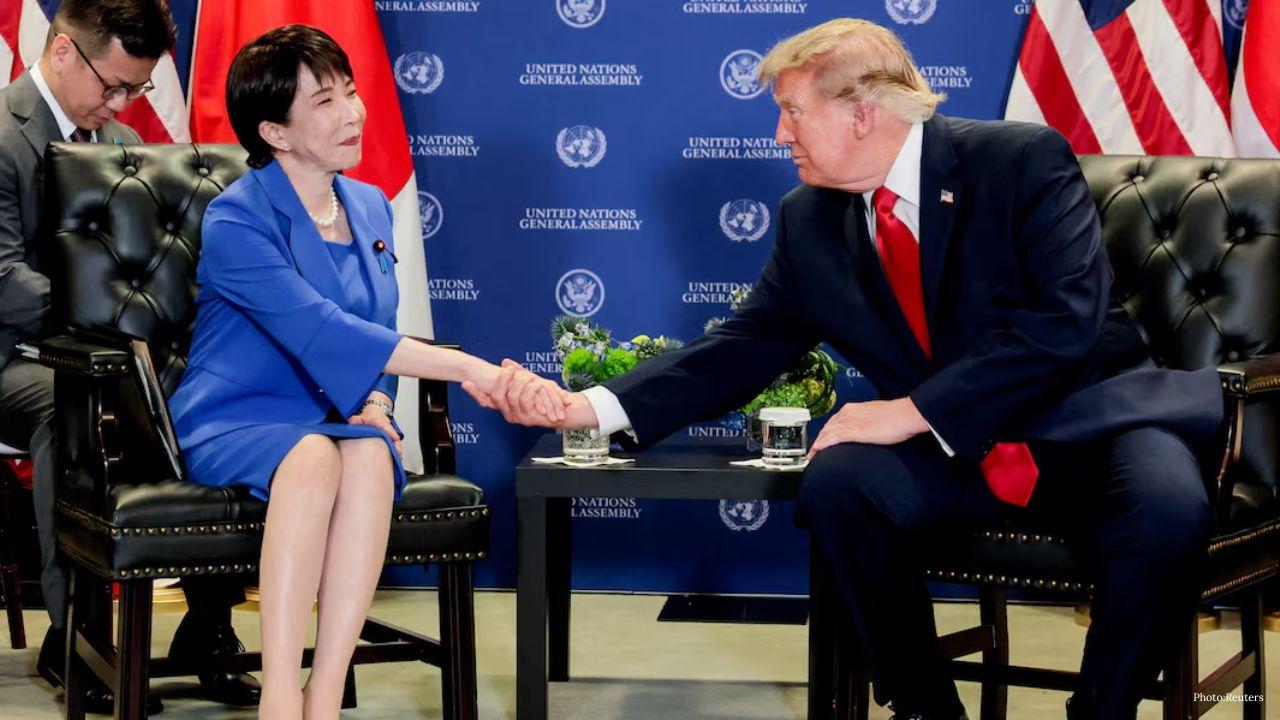
US President Donald Trump raised concerns about the continued weakness of the Japanese yen during his meeting with Japanese Prime Minister Sanae Takaichi, according to Japan's Finance Minister Satsuki Katayama. The issue was discussed during the Japan-US summit held on September 22 on the sidelines of the United Nations General Assembly in New York. The meeting brought the two leaders together at a time when movements in the foreign exchange market are drawing increased attention from policymakers in both countries. Katayama gave an unusually detailed account of the currency discussion on September 25, saying Trump had expressed concern about the yen's weakness. She said the information was being disclosed after consultation with the Prime Minister's Office.
According to Katayama, Takaichi responded to Trump's concern by explaining Japan's general position that an undervalued yen creates problems. The Japanese government has been closely monitoring the currency as the yen remains under pressure against the US dollar. A weaker yen can make Japanese exports more competitive overseas, but it also increases the cost of imported goods, particularly energy and raw materials. For Japan, which depends heavily on imports for energy supplies, currency movements can quickly affect domestic prices. A weaker yen means Japanese companies need more yen to purchase the same amount of goods priced in dollars. This can eventually put additional pressure on households and businesses through higher prices.
The Japanese currency has been facing pressure as the US dollar remains strong against major currencies. Recent market movements have been influenced by expectations surrounding US interest rates, US economic data and Treasury yields. Higher US yields can make dollar-denominated assets more attractive to investors, increasing demand for the US currency relative to the yen. Reuters reported on September 25 that the dollar was heading toward weekly gains as higher Treasury yields and expectations surrounding the Federal Reserve supported the US currency. The yen has consequently remained under pressure despite recent Japanese policy measures. The dollar was trading around 158 yen after Katayama's remarks, although the Japanese currency strengthened slightly following her comments.
The latest comments also come after Japan and the United States coordinated their response to sharp currency movements. Tokyo and Washington have previously agreed that exchange rates should be determined by market forces while authorities can respond to excessive volatility and disorderly movements. Katayama said the discussion between Trump and Takaichi reaffirmed the shared position behind the coordinated intervention carried out in July. She also said she would continue communicating closely with US Treasury Secretary Scott Bessent on foreign-exchange matters. The issue is being watched closely by investors because any fresh intervention by Japan could have consequences across global currency and bond markets.
One of the biggest concerns surrounding the weak yen is its impact on Japan's import bill. Japan imports a significant share of the energy it consumes. When the yen loses value against the dollar, imported oil, gas and other commodities become more expensive in yen terms. The situation becomes more complicated when global energy prices are already elevated because of geopolitical tensions. Higher energy costs can pass through to transportation, electricity, manufacturing and household expenses. Japan's policymakers therefore face a difficult balance. A weaker currency can provide advantages for exporters and companies earning revenue overseas, but prolonged weakness can also increase costs for consumers and businesses that depend on imported products. This is one reason the yen exchange rate has become an important economic issue for the Japanese government.
The currency debate is also connected to Japan's inflation outlook. A sustained decline in the yen can increase the domestic price of imported goods. If companies pass those higher costs on to consumers, inflation could remain elevated for longer. That creates a challenge for the Bank of Japan and the government as they attempt to balance economic growth, household purchasing power and financial stability. Recent market reporting has highlighted continued concern among Japanese officials about sharp currency movements. The government has also kept open the possibility of taking action if movements become excessive or disorderly. The situation has become particularly important because the yen has remained weak even after the Bank of Japan moved interest rates higher.
The weakness of the yen has increased attention on the Bank of Japan's monetary policy. The central bank has been gradually moving away from the extremely loose policy settings that characterized much of the previous decade. However, currency markets continue to assess whether Japanese interest rates can rise quickly enough to narrow the gap with US rates. That gap remains important for investors because higher interest rates in the United States can encourage capital to move toward dollar-denominated assets. At the same time, faster Japanese rate increases could create challenges for households, businesses and the government's borrowing costs. The yen's performance therefore depends on several factors at once, including interest-rate expectations, inflation, energy prices, government policy and international investor sentiment.
The currency issue was not the only subject discussed during the Trump-Takaichi meeting. Takaichi later told reporters that she and Trump had a timely discussion about China ahead of Trump's planned meeting with Chinese President Xi Jinping. The discussion took place during the UN General Assembly in New York, where international leaders were also holding a series of meetings on economic and geopolitical issues. The Japan-US relationship therefore remains important across several areas, including economic policy, regional security and relations with China. However, the public disclosure of the exchange-rate discussion has drawn particular attention because currency issues are normally handled with considerable diplomatic caution.
Read Also: Najib Seeks Stay of 15-Year Jail Sentence as Court Sets October 14 Hearing
The immediate direction of the USD JPY exchange rate will continue to depend on market expectations about US and Japanese interest rates, economic data and government intervention. Japanese authorities have repeatedly indicated that they are watching the currency market closely. Any sudden or disorderly movement could increase speculation about possible intervention. At the same time, investors will be monitoring statements from the US Treasury and Japanese Finance Ministry because coordination between the two countries could influence market expectations. For Japan, the central question is how to manage the economic effects of a weaker currency without creating additional instability in financial markets.
The latest Trump-Takaichi discussion highlights how the yen has moved beyond being a domestic Japanese economic issue. A sustained weak yen affects the cost of imported energy and goods in Japan, while major currency movements can also influence international investors, Japanese government bonds and global financial markets. Japan is one of the world's largest economies and a major holder of overseas financial assets. Changes in Japanese interest rates, bond yields and currency policy can therefore have effects beyond the country's borders. For now, Japanese officials and US policymakers remain focused on preventing excessive volatility rather than targeting a specific exchange rate.









OpenAI Says AI Agents Accidentally Posted 53 User Images Online
OpenAI says AI agents accidentally posted 53 ChatGPT user images online, raising new concerns over A

Virat Kohli Says 2027 World Cup Will Be His Last For India
Virat Kohli confirms the 2027 World Cup will be his last for India as he targets one final title bid

Weak Earthquake Hits Kinabatangan in Sabah Early Saturday Morning
A 3.3-magnitude Sabah Earthquake hit Kinabatangan early Saturday. Firefighters found no damage, whil

Europe's Biggest Leagues Demand Sweeping FIFA Reforms
Europe's top leagues demand FIFA reforms, stronger FIFA governance, stakeholder representation and c

Sri Lanka Economy Shows Resilience, But IMF Flags Growing Downside Risks
Sri Lanka economy remains resilient, but IMF warns of downside risks from energy costs, inflation an

Milne, Bracewell Return as Ravindra Misses New Zealand’s India T20 Series
New Zealand name squad for India T20 series as Rachin Ravindra misses the matches, while Adam Milne