
You have not yet added any article to your bookmarks!
Join 10k+ people to get notified about new posts, news and tips.
Do not worry we don't spam!
Post by : Anis Farhan
Photo: Reuters
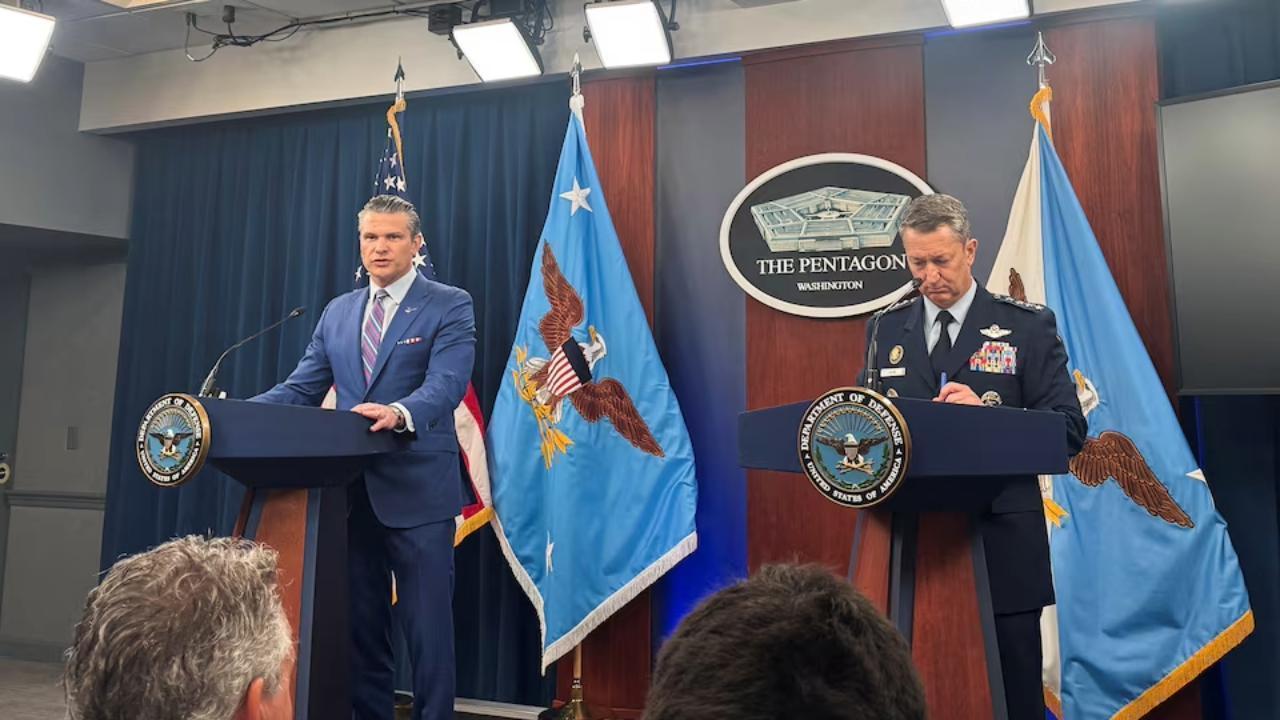
At a Pentagon briefing on June 26, U.S. Defense Secretary Pete Hegseth stated unequivocally that no intelligence indicates Iran relocated its highly enriched uranium ahead of U.S. airstrikes on three nuclear sites earlier this week. The military operation, which involved more than a dozen 30,000-pound bunker‑buster bombs, targeted the Fordow, Natanz, and Isfahan facilities as part of President Trump’s campaign to cripple Iran’s nuclear program.
Hegseth, speaking forcefully, said, “I’m not aware of any intelligence ... that says things were not where they were supposed to be, moved or otherwise.” He also criticized media coverage as slanted against the effectiveness of the strikes. Trump backed this position, posting that “concrete workers” and their equipment—not uranium—were seen at Fordow, adding it would have been “too dangerous” for Iran to remove the material in time.
Despite these denials, experts have raised doubts. Satellite imagery showed unusual vehicle activity at Fordow prior to the raid, and a senior Iranian source informed Reuters that much of Iran’s 60 percent enriched uranium was moved to undisclosed locations. European intelligence, cited by the Financial Times, noted that stockpiles likely remained intact because they weren’t concentrated at Fordow. A preliminary U.S. Defense Intelligence Agency assessment suggested the strikes may have only delayed, not dismantled, Iran’s nuclear program by a few months.
Hegseth dismissed that DIA report as “low confidence,” saying newer intelligence shows Iran’s nuclear infrastructure was “severely damaged” and would take years to rebuild. CIA Director John Ratcliffe also reportedly supported this timeline during a confidential Senate briefing that included Secretary of State Marco Rubio and General Dan Caine, who noted the strike’s technical success and the Patriot missile defense response at Al‑Udeid Air Base.
Despite public claims, some senior senators cautioned that only on‑ground inspections by international agencies like the IAEA could determine the true status of Iran’s nuclear inventory. Senator Mark Warner pointed out that warhead‑grade uranium could evade aerial attacks and remain hidden in fortified bunkers. Congress is preparing a resolution aimed at restricting future U.S. strikes without legislative approval, though prospects for its passage remain uncertain.
The exchanges highlight critical uncertainties. While the administration maintains Iran did not move its uranium and suffered historic damage, images and expert assessments hint that Tehran may have preemptively concealed key stockpiles. A definitive evaluation hinges on data from inspections and intelligence shared through diplomacy or oversight channels.










PM Modi Pays Tribute to Mahatma Gandhi, Urges People to Support Khadi
PM Modi pays tribute to Mahatma Gandhi on Gandhi Jayanti and urges citizens to support Khadi and the

Amazon Seeks to Offload $8 Billion in Nvidia Chips to Investors
Amazon plans to move $8 billion in Nvidia chips to investors, using a new financing model to strengt

Samsung Raises Galaxy S26 Prices as Memory Chip Costs Rise
Samsung raises Galaxy S26 prices in South Korea as rising memory chip costs put pressure on smartpho

Lewis Hamilton Calls Singapore Grand Prix One of F1's Toughest Races
Lewis Hamilton discusses the demanding Singapore Grand Prix and brings Plus44 and Almave to Singapor

Denmark's Pandora Opens World's Largest Jewellery Factory in Vietnam
Pandora opens its largest jewellery factory in Vietnam, expanding global production, strengthening s

Gautam Gambhir Questions Batting-Friendly Pitches After India's Record ODI Chase
Gautam Gambhir questions batting-friendly ODI pitches after India’s record chase, calling for a bett

