
You have not yet added any article to your bookmarks!
Join 10k+ people to get notified about new posts, news and tips.
Do not worry we don't spam!
Post by : Shakul
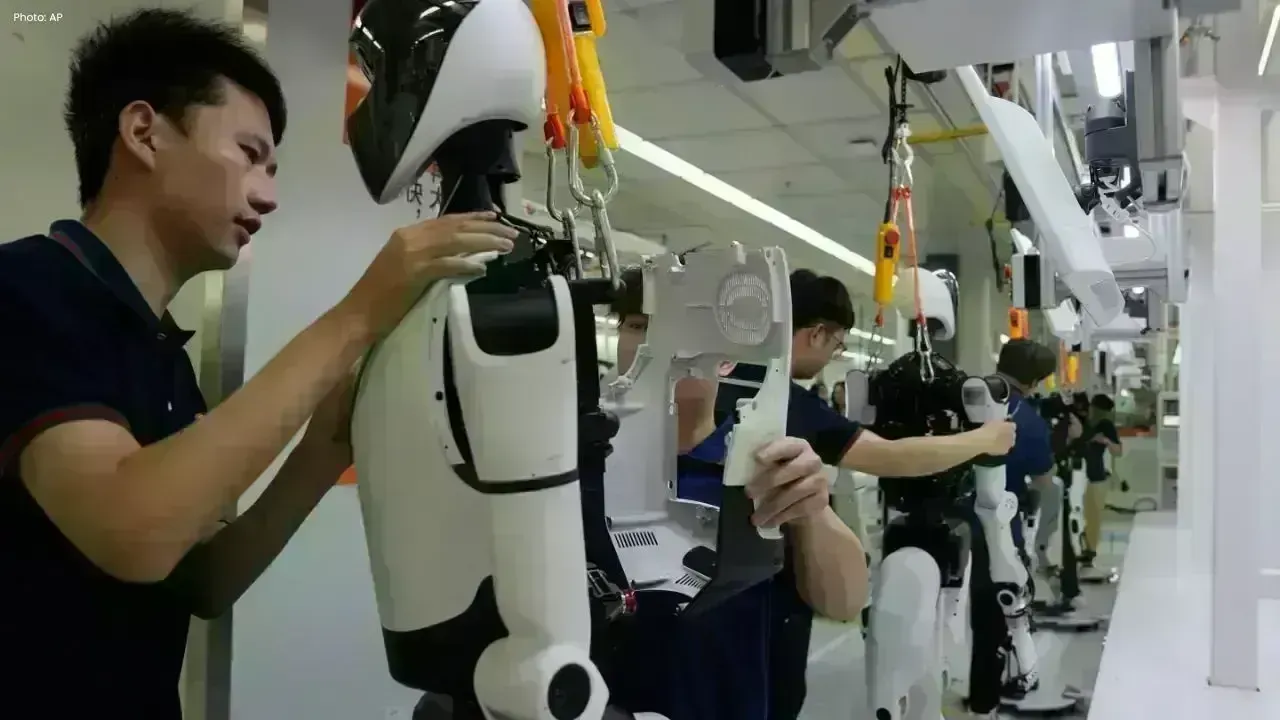
China’s humanoid robotics industry is expanding at an extraordinary pace, positioning the country as a global leader in robot manufacturing. While Chinese companies have demonstrated impressive technological capabilities and secured thousands of orders, industry experts believe the next major challenge is generating sufficient demand to match rapidly growing production capacity.
Across China, humanoid robots are increasingly being showcased performing complex tasks such as making coffee, guiding visitors, sorting packages, directing traffic, and assisting in customer service roles. These demonstrations highlight the country's ambition to become the dominant force in a market that analysts predict could be worth trillions of dollars in the coming decades.
Leading Chinese robotics firms have invested heavily in developing advanced AI-powered machines. Companies such as Matrix Robotics and EngineAI have introduced humanoid robots capable of carrying out a range of commercial and industrial functions. Supported by strong manufacturing infrastructure and government backing, these companies are scaling production faster than many of their international competitors.
Despite rapid technological progress, experts caution that most humanoid robots remain limited in practical real-world applications. Many machines perform effectively in controlled environments but struggle to adapt to unpredictable situations commonly found in homes, factories, and public spaces. As a result, large-scale commercial adoption remains slower than anticipated.
Industry analysts note that while China currently dominates global humanoid robot shipments, a significant share of purchases comes from research institutions, state-owned enterprises, and pilot projects rather than widespread consumer demand. The high cost of production, maintenance requirements, and limited operational flexibility continue to restrict broader deployment across industries.
China's government has identified robotics and artificial intelligence as strategic sectors for future economic growth. Extensive investments, favorable policies, and technological innovation have helped local manufacturers gain a competitive advantage. Chinese firms now account for the majority of global humanoid robot shipments and continue to introduce increasingly affordable models.
Looking ahead, industry leaders believe that advances in artificial intelligence, data collection, and machine learning will gradually improve robot capabilities and reduce costs. As the technology matures, humanoid robots could become more common in logistics centers, factories, healthcare facilities, and households. However, achieving mass adoption will depend not only on manufacturing strength but also on proving that these machines can deliver reliable value in everyday life.










PM Modi Pays Tribute to Mahatma Gandhi, Urges People to Support Khadi
PM Modi pays tribute to Mahatma Gandhi on Gandhi Jayanti and urges citizens to support Khadi and the

Amazon Seeks to Offload $8 Billion in Nvidia Chips to Investors
Amazon plans to move $8 billion in Nvidia chips to investors, using a new financing model to strengt

Samsung Raises Galaxy S26 Prices as Memory Chip Costs Rise
Samsung raises Galaxy S26 prices in South Korea as rising memory chip costs put pressure on smartpho

Lewis Hamilton Calls Singapore Grand Prix One of F1's Toughest Races
Lewis Hamilton discusses the demanding Singapore Grand Prix and brings Plus44 and Almave to Singapor

Denmark's Pandora Opens World's Largest Jewellery Factory in Vietnam
Pandora opens its largest jewellery factory in Vietnam, expanding global production, strengthening s

Gautam Gambhir Questions Batting-Friendly Pitches After India's Record ODI Chase
Gautam Gambhir questions batting-friendly ODI pitches after India’s record chase, calling for a bett

