
You have not yet added any article to your bookmarks!
Join 10k+ people to get notified about new posts, news and tips.
Do not worry we don't spam!
Post by : Anis Farhan
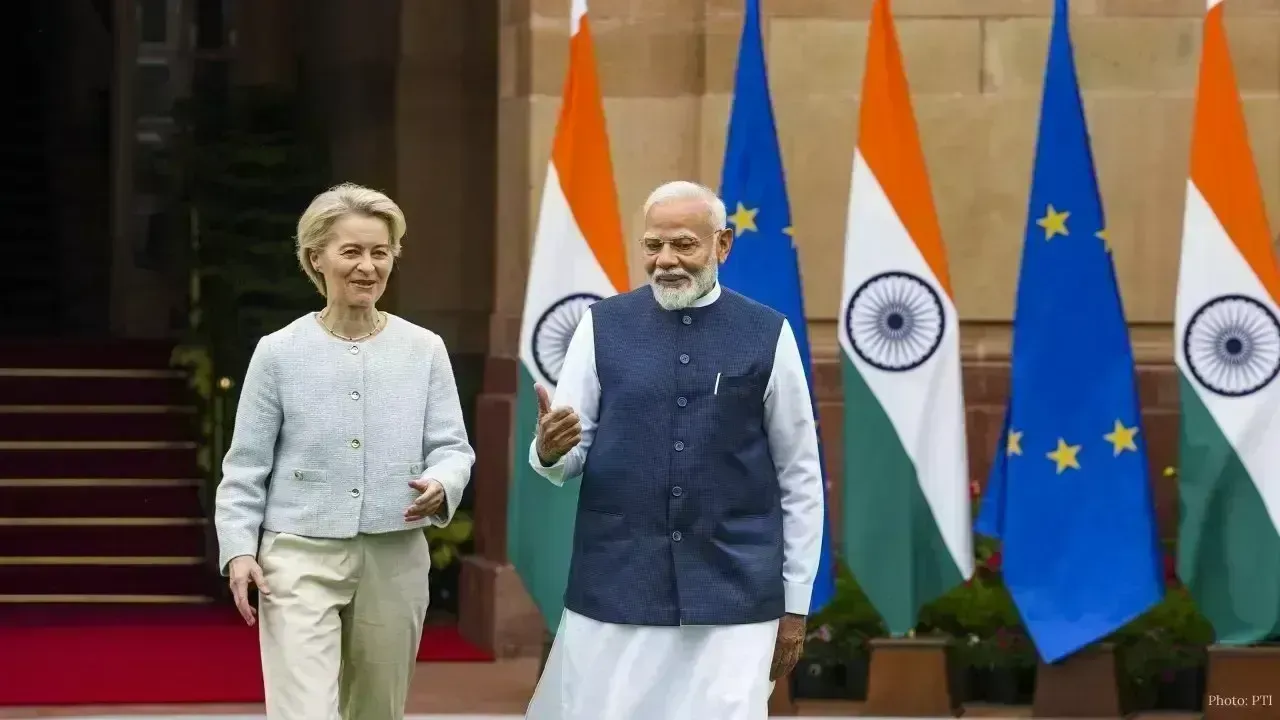
India is preparing for a high-profile visit by senior European Union leaders, including European Council President António Luis Santos da Costa and European Commission President Ursula von der Leyen, who will be present as chief guests at India’s Republic Day celebrations on January 26, 2026.
Accompanying the ceremonial role is a strategically significant diplomatic agenda — the 16th India-EU Summit scheduled for January 27, 2026, where the long-pending India-EU Free Trade Agreement (FTA) could finally be concluded and formally announced.
The forthcoming visit signifies not simply a ceremonial appearance but a potential turning point in India-EU economic relations, as both sides edge closer to sealing a pact that has been in negotiation for nearly two decades.
Negotiations for a comprehensive free trade agreement between India and the EU were first launched in 2007 but stalled for many years due to disagreements over market access, tariffs, regulatory barriers and sensitive sectors such as agriculture and automobiles.
After a prolonged hiatus, talks were relaunched in 2022, against the backdrop of rapid global economic changes, rising protectionism, and geopolitical uncertainty. The attempted pact reflects both sides’ desire to integrate markets and diversify supply chains amid increasing global trade fragmentation.
Over the past year, negotiations accelerated substantially. According to officials, most aspects of the agreement have been concluded, with only a few remaining points of contention yet to be resolved. Indian Commerce Secretary Rajesh Agrawal noted that India and the EU are “very close” to finalising the pact, with teams actively engaging to narrow differences ahead of the summit.
German Chancellor Friedrich Merz — whose recent visit to India underscored economic and security cooperation — even suggested that the deal could be concluded by the end of January, setting the stage for its formal announcement during the EU leaders’ visit.
This renewed pace reflects both political will and strategic alignment, making the India-EU FTA possibly one of India’s largest and most consequential trade agreements to date.
For the first time, senior leaders of the European Union as a bloc — not just individual heads of state — will attend India’s Republic Day celebrations, a rare recognition that underscores the strength of India-EU relations.
Historically, the choice of chief guest for Republic Day reflects India’s diplomatic priorities and close partnerships. In this instance, it reinforces the EU’s emergence as a vital strategic and economic partner.
During their three-day state visit from January 25-27, the EU contingent will participate in ceremonial events, bilateral talks with Indian leadership, and an India-EU Business Forum aimed at deepening commercial ties and investment cooperation.
The proposed India-EU Free Trade Agreement (FTA) seeks to reduce tariffs and non-tariff barriers, enhance market access for goods and services, ensure investment protection and promote regulatory cooperation between India and the 27-nation bloc that includes major economies such as France, Germany, Italy, Spain and the Netherlands.
Commerce and Industry Minister Piyush Goyal has described the forthcoming pact as the “mother of all deals,” highlighting its potential to significantly expand economic activity and bilateral trade.
This level of trade liberalisation would involve both sides committing to mutual commitments across a wide spectrum of economic activities — from industrial goods, textiles and pharmaceuticals to services, investment, and possibly some sensitive categories.
While progress is strong, certain sectors remain sensitive and require careful negotiation. The EU has sought lower import duties on automobiles — where tariff rates in India can exceed 100 per cent — and greater access for products such as medical devices, wine, and spirits. India, on the other hand, has been cautious about fully liberalising sectors like agriculture and dairy, which are politically and economically sensitive for domestic producers.
Other contentious areas include regulatory standards, rules of origin, and carbon adjustment mechanisms, particularly in sectors such as steel, which India fears could be adversely affected by European environmental policies.
Negotiators aim to strike a balanced agreement that enhances trade without undermining strategic economic interests on either side, and officials remain optimistic that remaining differences can be resolved in time for the summit.
The India-EU relationship extends beyond traditional economic cooperation into strategic domains such as technology, clean energy transition, defence collaboration, and connectivity. The FTA is part of a broader agenda that aligns economic interests with shared geopolitical values — including support for a rules-based international order and efforts to diversify trading partnerships away from excessive dependence on any single market.
Experts view India’s growing economic and diplomatic stature as pivotal for Europe’s strategic ambitions in the Indo-Pacific region, providing the EU with a crucial partner amid global uncertainty and shifting geopolitical alignments.
The prospective conclusion of the India-EU FTA carries significant implications for global trade dynamics. For Europe, enhancing market access to India — a rapidly growing economy with over 1.4 billion people — strengthens economic diversification and resilience against protectionism and supply-chain disruptions.
For India, the pact would deepen integration with advanced global value chains, potentially boosting exports in textiles, pharmaceuticals, information technology services and other labour-intensive sectors. Increased investor confidence could follow, fostering long-term economic growth.
Together, these factors could reshape trade flows between two of the world’s largest economic regions, influencing other trade negotiations and partnerships worldwide.
If finalised, the FTA would create enhanced market access for Indian products in the European Union — currently India’s largest trading partner for goods. Potential reductions in tariffs and streamlined regulatory frameworks could make Indian exports more competitive in European markets.
Indian sectors likely to benefit include textiles and apparel, leather goods, pharmaceuticals, engineering products, chemicals, and machinery. Lower tariff barriers in the EU could translate into increased orders, enhanced scale economies, and improved foreign exchange earnings.
Deeper trade engagement could also unlock investment opportunities, creating jobs and stimulating growth in sectors aligned with global demand. European firms might expand investments in India, attracted by greater market access and strengthened protections under the pact.
Conversely, India must balance increased competition in certain sensitive sectors with domestic economic priorities — a negotiation challenge that underpins much of the ongoing dialogue.
For India, trade policy must navigate complex domestic priorities while pursuing international integration. Protecting livelihoods in sectors such as agriculture, dairy, and small-scale manufacturing remains politically important, which influences how tariffs and market access are negotiated.
Similarly, Europe must balance the interests of its member economies and industries — particularly those sensitive to competition from imports — while advancing broader strategic goals in partnership with India.
The India-EU Summit on January 27, 2026 is widely expected to serve as a platform where the proposed free trade deal could be formally announced or showcased, even if some technical legal text is finalised later.
This summit — coming immediately after India’s Republic Day celebrations — reinforces the political symbolism and strategic depth of the India-EU partnership. As chief guests at the Republic Day parade, European leaders will highlight shared values of democracy, economic cooperation, and global stability, underscoring the multi-dimensional nature of the relationship.
Looking ahead, this deal may pave the way for further cooperation in other areas such as digital trade, climate technologies, critical materials, and defence industries — broadening the scope of India-EU ties well beyond traditional economics.
The impending visit of top European Union leaders to India for Republic Day and the India-EU Summit represents a historic diplomatic and economic moment. With the free trade agreement nearing completion after years of negotiation, the partnership between India and the EU is poised for a major breakthrough.
If concluded, the pact would become one of India’s most significant trade agreements, reshaping economic relations with a bloc of 27 developed economies, boosting trade flows, investments and strategic cooperation. As both sides prepare for the summit, the consensus is clear: the India-EU trade deal is more than an economic pact — it is a signal of shared ambition, mutual respect, and a stronger global partnership in a rapidly changing world.
Disclaimer:
This article is based on current public reports and analysis of India-EU negotiations and diplomatic developments. Trade negotiations are complex and subject to ongoing discussions and political decisions. Readers are encouraged to follow future updates for official confirmation of agreements.










PM Modi Pays Tribute to Mahatma Gandhi, Urges People to Support Khadi
PM Modi pays tribute to Mahatma Gandhi on Gandhi Jayanti and urges citizens to support Khadi and the

Amazon Seeks to Offload $8 Billion in Nvidia Chips to Investors
Amazon plans to move $8 billion in Nvidia chips to investors, using a new financing model to strengt

Samsung Raises Galaxy S26 Prices as Memory Chip Costs Rise
Samsung raises Galaxy S26 prices in South Korea as rising memory chip costs put pressure on smartpho

Lewis Hamilton Calls Singapore Grand Prix One of F1's Toughest Races
Lewis Hamilton discusses the demanding Singapore Grand Prix and brings Plus44 and Almave to Singapor

Denmark's Pandora Opens World's Largest Jewellery Factory in Vietnam
Pandora opens its largest jewellery factory in Vietnam, expanding global production, strengthening s

Gautam Gambhir Questions Batting-Friendly Pitches After India's Record ODI Chase
Gautam Gambhir questions batting-friendly ODI pitches after India’s record chase, calling for a bett

