
You have not yet added any article to your bookmarks!
Join 10k+ people to get notified about new posts, news and tips.
Do not worry we don't spam!
Post by : Jyoti Gupta
Photo:PTI
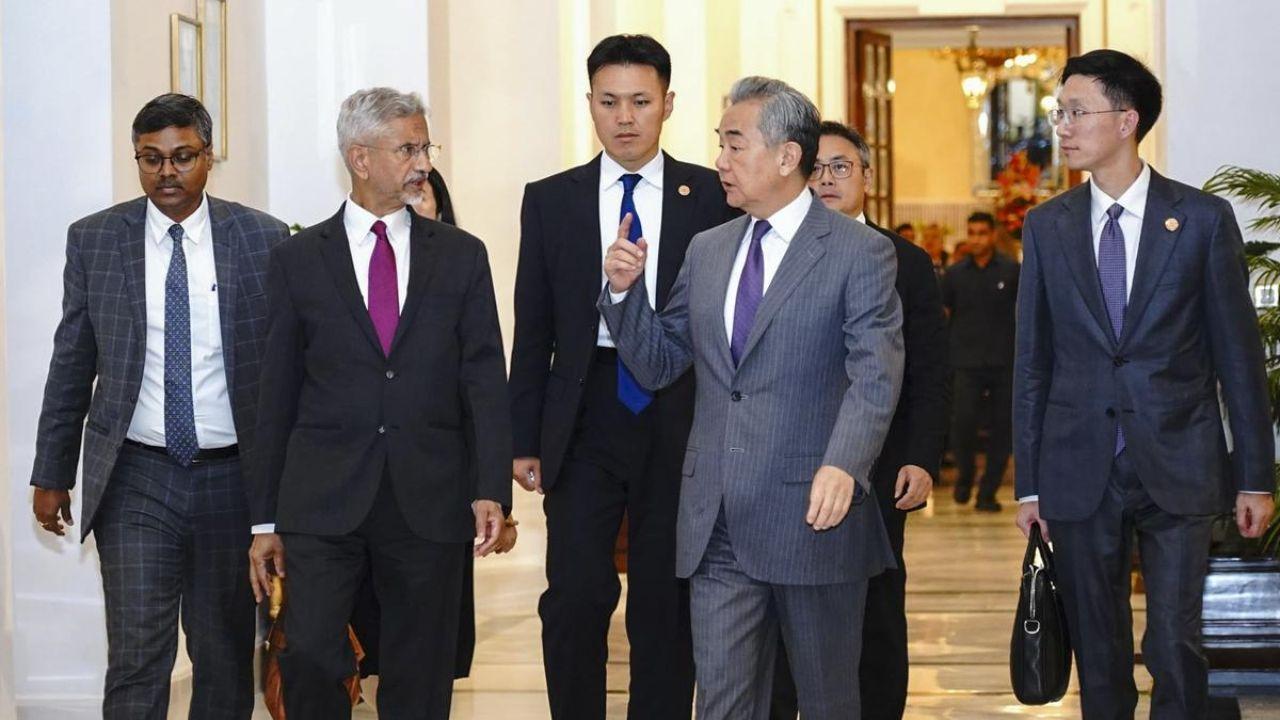
India and China have started a new round of diplomatic and security talks in New Delhi, in an effort to ease the long-running tensions along their disputed border and to prepare the ground for future cooperation. The visit of Chinese Foreign Minister Wang Yi, who arrived in the Indian capital on Monday, August 18, 2025, has come at a time when both sides are still struggling to settle the border standoff that began more than five years ago.
Jaishankar’s Clear Message
On Monday, External Affairs Minister S. Jaishankar held detailed discussions with Wang Yi. In the meeting, Jaishankar underlined that the disengagement process of troops at the Line of Actual Control (LAC) “needs to move forward.” He told his counterpart that while some agreements have been implemented in the past, large sections of the border remain heavily militarized, which continues to create tension and mistrust.
According to officials present in the meeting, Jaishankar insisted that peace and tranquility along the border are the foundation of India–China ties. He pointed out that the public and political mood in India would not allow relations to move into a normal phase until there is visible progress on reducing military presence in sensitive areas.
Wang Yi’s India Visit – Purpose and Timing
The two-day visit of Wang Yi is seen as an important diplomatic effort ahead of Prime Minister Narendra Modi’s upcoming trip to China for the Shanghai Cooperation Organisation (SCO) summit at the end of August. The SCO summit will be a major international event, bringing together leaders from Russia, Central Asia, Pakistan, China, and India. Both sides want to ensure that Modi’s visit takes place in a constructive atmosphere, without being overshadowed by fresh border clashes.
Wang’s visit has two goals. First, to review progress in disengagement and address remaining friction points along the LAC. Second, to prepare political ground for Modi’s arrival in Beijing, where he is expected to hold bilateral talks with Chinese President Xi Jinping on the sidelines of the SCO summit.
Upcoming Meeting with Ajit Doval
On Tuesday, August 19, Wang Yi will also meet India’s National Security Advisor Ajit Doval. This will mark the 24th round of the Special Representative talks on the boundary issue — a mechanism established in 2003 to find a political solution to the dispute.
The meeting between Doval and Wang Yi is expected to focus heavily on de-escalation measures. Sources say the Indian side is likely to press for a phased withdrawal of troops in the Depsang Plains, Demchok, and other friction areas. These sectors remain heavily militarized despite previous disengagement agreements in Pangong Tso and Galwan Valley. India has been consistently warning that the slow pace of Chinese troop withdrawal is not acceptable, and that confidence-building cannot proceed unless there is visible progress.
Historical Background of the Dispute
India and China share a 3,488-kilometer-long, undemarcated border known as the Line of Actual Control. Since the 1962 war between the two countries, tensions have flared up from time to time. The most serious clash in decades occurred in June 2020 at Galwan Valley, where 20 Indian soldiers and at least 4 Chinese troops were killed in hand-to-hand combat.
Since then, several rounds of military and diplomatic talks have taken place. While disengagement has been achieved in some areas, others remain unresolved. Both armies continue to maintain heavy deployments, including armored vehicles, artillery, and advanced surveillance systems. This has led to concerns about accidental escalation and renewed clashes.
Trade and Economic Cooperation
Despite political tensions, trade between India and China remains significant. China continues to be India’s largest trading partner, though bilateral trade has slowed in recent years due to India’s push for self-reliance and reduced dependence on Chinese imports in sensitive sectors such as electronics, telecommunications, and pharmaceuticals.
During Monday’s discussions, Jaishankar and Wang also touched on trade barriers, investment opportunities, and regional economic cooperation. The Indian side emphasized the need for fair market access for Indian products in China. Observers say that both sides are aware that trade is a stabilizing factor, but strategic mistrust limits its potential.
Regional and Global Context
The timing of Wang’s visit is also important from a regional and global perspective. The SCO summit is expected to focus on security in Afghanistan, counter-terrorism, and economic connectivity in Eurasia. Both India and China, as major Asian powers, will play a central role in shaping the discussions.
At the same time, both countries are navigating complex relationships with global powers. India has strengthened its ties with the United States, Japan, and Australia through the Quad grouping, while China continues to align closely with Russia. For both nations, finding a way to manage their rivalry while cooperating in regional forums is a diplomatic balancing act.
The Road Ahead
Diplomatic analysts say that the success of Wang Yi’s visit will be measured not only by the words spoken in Delhi but also by the concrete actions that follow. If the two sides can agree on timelines for troop withdrawal or at least take steps to reduce forward deployments, it will be seen as progress. However, if discussions only result in broad statements without movement on the ground, mistrust is likely to deepen.
Still, the very fact that both governments are engaging at such a high level is seen as a positive sign. In recent years, relations between India and China have been described as being at their “most difficult phase” since 1962. The willingness to talk openly and prepare for leadership-level meetings shows that both sides recognize the cost of prolonged confrontation.
Wang Yi’s two-day visit to New Delhi marks a crucial moment in India–China relations. With Jaishankar’s firm call for faster troop disengagement and the upcoming meeting with Ajit Doval, the focus is clearly on reducing border tensions. At the same time, trade and regional cooperation remain important parts of the agenda. As both countries prepare for Prime Minister Modi’s visit to China for the SCO summit, the outcome of these talks will set the tone for whether the relationship moves toward reconciliation or remains locked in suspicion.










PM Modi Pays Tribute to Mahatma Gandhi, Urges People to Support Khadi
PM Modi pays tribute to Mahatma Gandhi on Gandhi Jayanti and urges citizens to support Khadi and the

Amazon Seeks to Offload $8 Billion in Nvidia Chips to Investors
Amazon plans to move $8 billion in Nvidia chips to investors, using a new financing model to strengt

Samsung Raises Galaxy S26 Prices as Memory Chip Costs Rise
Samsung raises Galaxy S26 prices in South Korea as rising memory chip costs put pressure on smartpho

Lewis Hamilton Calls Singapore Grand Prix One of F1's Toughest Races
Lewis Hamilton discusses the demanding Singapore Grand Prix and brings Plus44 and Almave to Singapor

Denmark's Pandora Opens World's Largest Jewellery Factory in Vietnam
Pandora opens its largest jewellery factory in Vietnam, expanding global production, strengthening s

Gautam Gambhir Questions Batting-Friendly Pitches After India's Record ODI Chase
Gautam Gambhir questions batting-friendly ODI pitches after India’s record chase, calling for a bett

