
You have not yet added any article to your bookmarks!
Join 10k+ people to get notified about new posts, news and tips.
Do not worry we don't spam!
Post by : Saif Rahman
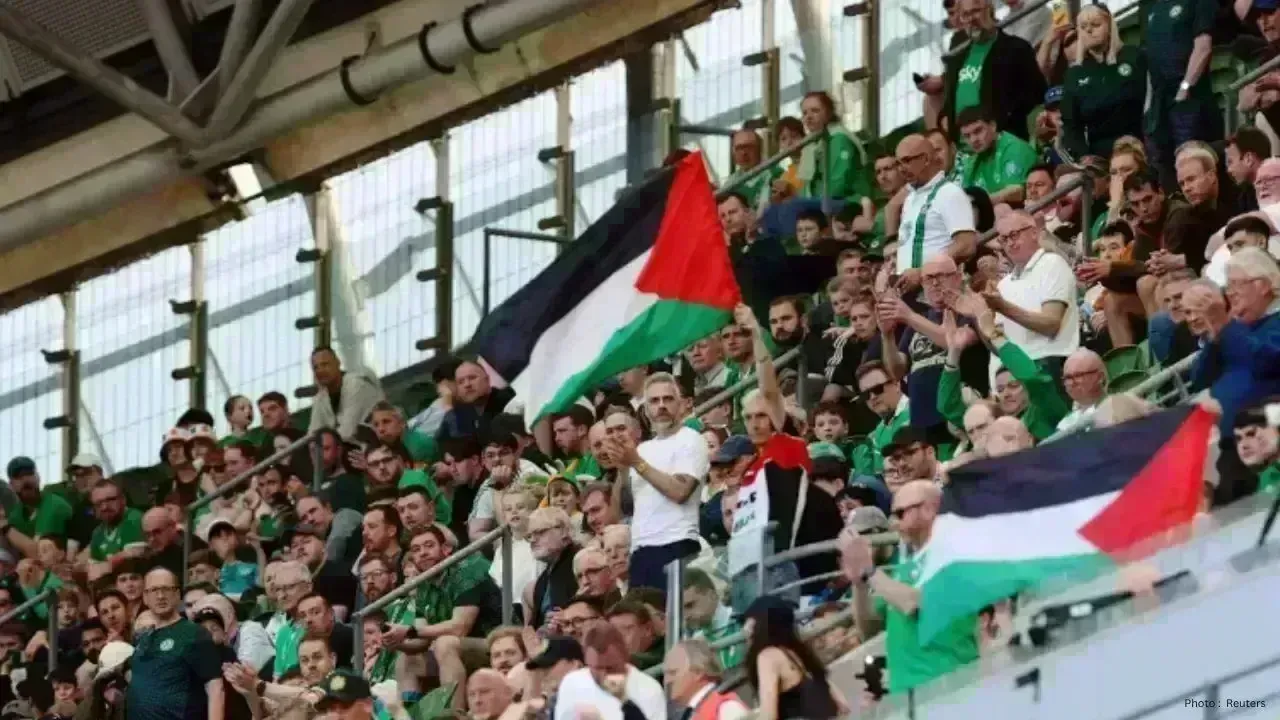
A protest during the Ireland versus Qatar football match has amplified focus on the escalating issues concerning Israel and the intersection of political activism within global sports.
This incident has heightened scrutiny on football governing bodies as discussions persist about the influence of political matters on global sports and athlete engagement.
Protesters reportedly showcased messages related to the ongoing Israel conflict during the game, eliciting vigorous responses from spectators, officials, and political analysts. The demonstration garnered worldwide attention and sparked renewed debate about the appropriateness of political expression in sporting arenas.
Traditionally, football has been seen as a unifying force, bridging cultures and nations. Yet, international matches are increasingly serving as platforms for fans and activist groups to air political, social, and humanitarian issues.
This latest protest illustrates the mounting rifts among global sports groups regarding Middle Eastern conflicts and the role of athletes, fans, and football organizations in these political dialogues.
Sports regulatory bodies typically strive to maintain a boundary between political expression and official contests. Organizations like FIFA and UEFA uphold regulations to prevent political messaging during matches in a bid to preserve the neutrality of sports.
Conversely, activists contend that major sports events often mirror broader global challenges and should not be wholly detached from critical international matters.
The demonstration at the Ireland-Qatar match is likely to instigate further discussions within football federations about crowd management protocols, policies regarding fan behavior, and regulations related to political expressions in stadiums.
Political tensions surrounding Israel have impacted various international sporting events in recent years. Athlete protests, fan demonstrations, and calls for sanctions have repeatedly sparked controversies across different competitions.
The increasing fusion of sports and politics places pressure on governing organizations to juggle the right to free expression with the necessity of maintaining decorum and neutrality during international events.
Football commands immense global attention, captivating millions of viewers worldwide. Consequently, political demonstrations occurring during matches often attract significant media coverage.
Experts indicate that future tournaments and international matches might necessitate enhanced security measures and stricter oversight if political protests persist in stadiums.
This recent episode may also raise diplomatic challenges for organizers hosting multinational sporting events where political sensitivities are acute. Event management teams are now expected to prepare for protests tied to global conflicts and humanitarian struggles.
Advocates of political activism in sports assert that athletes and fans deserve the platform to express their views on pressing global issues. In contrast, detractors argue that sporting events should focus solely on the realm of competition, devoid of political controversies.
The discourse on political messaging in football transcends single conflicts or regions, as similar issues arise related to racism, human rights, war, discrimination, and social justice within global sports endeavors.
International football authorities are expected to scrutinize the recent developments closely as pressure mounts to specify rules for political expression within stadiums and during official matches.
This incident during the Ireland-Qatar match underscores how global political tensions are increasingly seeping into the sporting domain. Football, once perceived mainly as a form of entertainment and competition, is evolving into a platform that engages with wider international discussions on politics, identity, and public advocacy.
As feedback continues to pour in from fans, sports officials, and political factions, the controversy surrounding protests linked to Israel is escalating.










PM Modi Pays Tribute to Mahatma Gandhi, Urges People to Support Khadi
PM Modi pays tribute to Mahatma Gandhi on Gandhi Jayanti and urges citizens to support Khadi and the

Amazon Seeks to Offload $8 Billion in Nvidia Chips to Investors
Amazon plans to move $8 billion in Nvidia chips to investors, using a new financing model to strengt

Samsung Raises Galaxy S26 Prices as Memory Chip Costs Rise
Samsung raises Galaxy S26 prices in South Korea as rising memory chip costs put pressure on smartpho

Lewis Hamilton Calls Singapore Grand Prix One of F1's Toughest Races
Lewis Hamilton discusses the demanding Singapore Grand Prix and brings Plus44 and Almave to Singapor

Denmark's Pandora Opens World's Largest Jewellery Factory in Vietnam
Pandora opens its largest jewellery factory in Vietnam, expanding global production, strengthening s

Gautam Gambhir Questions Batting-Friendly Pitches After India's Record ODI Chase
Gautam Gambhir questions batting-friendly ODI pitches after India’s record chase, calling for a bett

