
You have not yet added any article to your bookmarks!
Join 10k+ people to get notified about new posts, news and tips.
Do not worry we don't spam!
Post by : Jyoti Gupta
Photo:AFP
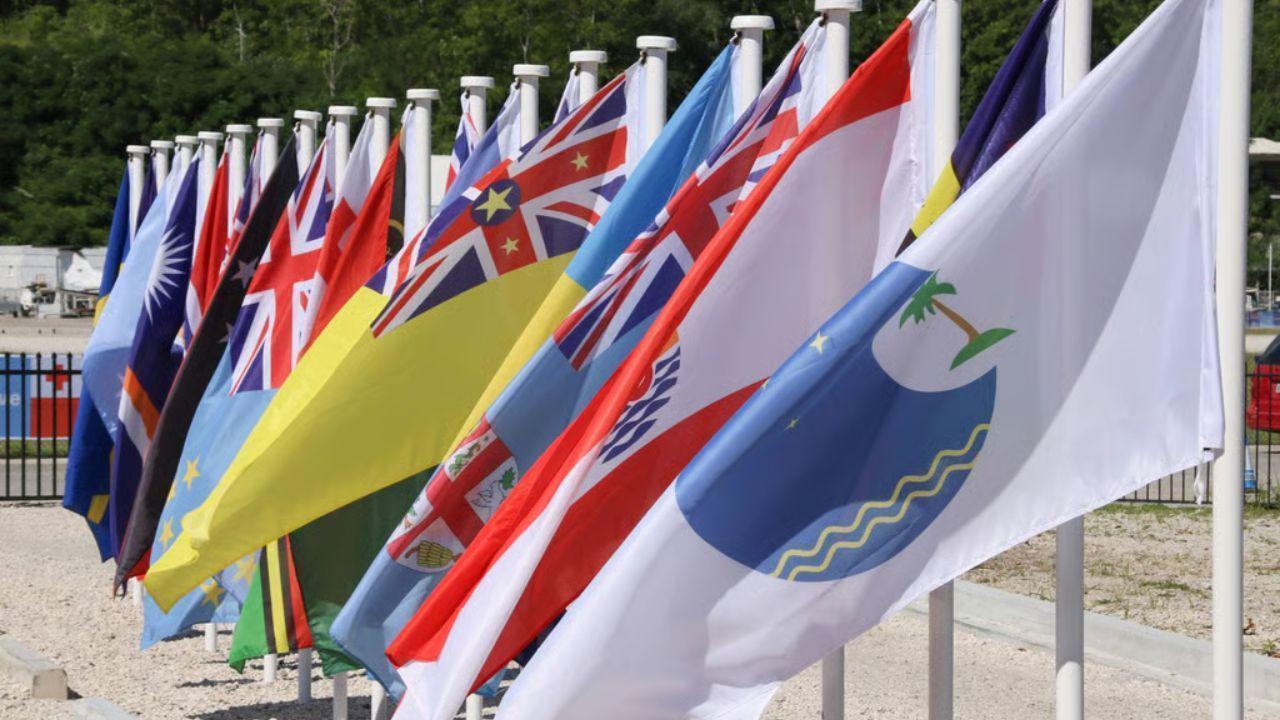
The Pacific Islands Forum (PIF), the main political body that brings together 18 nations and territories of the Pacific, is set to meet in Honuara, Solomon Islands, from September 8 to 12. But this year’s gathering is already making headlines for a major reason: the Solomon Islands government has decided to bar all external dialogue partners from attending the summit.
This decision, announced earlier in August by Prime Minister Jeremiah Manele, means that 21 donor and development partners – including the United States, China, Japan, India, the European Union, and others – will not take part in the forum this year. The announcement has opened up intense debate across the Pacific and beyond, raising questions about the region’s independence, its unity, and the influence of global powers on its internal affairs.
Why the Solomon Islands Took This Step
The Solomon Islands switched diplomatic ties from Taiwan to China in 2019, becoming one of Beijing’s closest security and economic partners in the Pacific. Since then, China has become a dominant player in the country, investing in infrastructure, security cooperation, and political support.
According to several regional observers, the main reason behind the ban was to avoid controversy surrounding Taiwan’s possible participation. Beijing strongly opposes any recognition of Taiwan as a separate state, and insists that countries adhere to the “One China” principle.
If Taiwan were allowed to attend even informally, China might have reacted forcefully. On the other hand, if Taiwan alone had been excluded, pro-Taiwan Pacific nations such as the Marshall Islands, Palau, and Tuvalu might have boycotted the summit. By banning all dialogue partners, Solomon Islands tried to avoid choosing sides – a decision that some see as pragmatic, but others view as controversial.
Unity or Division in the Pacific?
The Pacific Islands Forum has historically operated on consensus. Since its founding in the 1970s, its main goal has been to unite the Pacific under one voice in dealing with global challenges like climate change, trade, and security. But the latest decision shows how external rivalries – especially between China, the United States, and Taiwan – are beginning to divide the region.
Analysts point out that while barring all external partners prevents open conflict during the summit, it also highlights the fragile unity of the Pacific. Leaders will now meet in a “Pacific-only” format, a move that some argue could revive the spirit of the forum’s early years when meetings were held behind closed doors, without outside interference.
Mixed Reactions Across the Region
The move has triggered varied reactions from Pacific leaders, diplomats, and outside governments:
* Supporters of the decision argue that this is the best way to let Pacific leaders talk directly to one another, without being overshadowed by major powers. Former diplomats and researchers have said that the meeting should focus on regional priorities like climate action, ocean protection, and economic development rather than scripted speeches from outsiders.
* Critics of the decision believe it risks weakening ties with important partners. The United States expressed “disappointment,” while New Zealand warned that excluding external voices could divide rather than strengthen the region.
* China, however, welcomed the move, saying it supports the forum’s independence and unity, while rejecting accusations that Beijing pressured the Solomon Islands to act in this way.
* Taiwan, which has supported Pacific nations since the 1980s and has been a forum partner since 1993, expressed regret but said it “understands” the decision.
The Geopolitical Shadow
For decades, the Pacific Islands were seen as relatively free from the world’s great-power conflicts. But in recent years, competition between China and the United States has spilled into the region, with both sides offering aid, loans, and military cooperation to win allies.
The Solomon Islands itself has signed security and infrastructure agreements with China, raising concerns among other Pacific nations as well as Australia and the US. Some experts worry that the PIF’s credibility as a united bloc will suffer if it is seen as bending too much to Chinese interests.
Others, however, argue that the Pacific nations must find their own path, not allowing themselves to be used as “battlegrounds” for bigger powers. As one Pacific scholar put it, “Unity in the Pacific is not about agreeing on everything, but about respecting each other’s choices while working together.”
What This Means for the Future of the Forum
The Honiara summit is expected to be a turning point. By holding a “Pacific-only” meeting, the Solomon Islands is testing whether the region can still find common ground internally before engaging with the outside world.
If successful, this could strengthen the PIF’s independence, showing that the Pacific does not need to rely heavily on donor partners to set its agenda. But if disagreements resurface or if development partners lose interest, the region could face setbacks in tackling urgent issues such as climate change, rising sea levels, fisheries, and sustainable development.
Experts warn that if donor countries feel sidelined, they may shift from multilateral cooperation with the PIF to bilateral deals with individual nations. This could reduce the collective bargaining power of Pacific states on the global stage.
A Critical Moment for Pacific Leadership
The upcoming PIF summit in Honiara will therefore not just be another annual meeting. It will be a test of Pacific unity, independence, and resilience in the face of mounting external pressures.
The Solomon Islands’ choice has placed the region at a crossroads: either prove that it can resolve its internal challenges and act with one voice, or risk deepening divisions that outside powers could exploit.
For the Pacific people, the summit will be closely watched as a moment when their leaders must decide whether to compromise for unity or confront the fractures head-on.










PM Modi Pays Tribute to Mahatma Gandhi, Urges People to Support Khadi
PM Modi pays tribute to Mahatma Gandhi on Gandhi Jayanti and urges citizens to support Khadi and the

Amazon Seeks to Offload $8 Billion in Nvidia Chips to Investors
Amazon plans to move $8 billion in Nvidia chips to investors, using a new financing model to strengt

Samsung Raises Galaxy S26 Prices as Memory Chip Costs Rise
Samsung raises Galaxy S26 prices in South Korea as rising memory chip costs put pressure on smartpho

Lewis Hamilton Calls Singapore Grand Prix One of F1's Toughest Races
Lewis Hamilton discusses the demanding Singapore Grand Prix and brings Plus44 and Almave to Singapor

Denmark's Pandora Opens World's Largest Jewellery Factory in Vietnam
Pandora opens its largest jewellery factory in Vietnam, expanding global production, strengthening s

Gautam Gambhir Questions Batting-Friendly Pitches After India's Record ODI Chase
Gautam Gambhir questions batting-friendly ODI pitches after India’s record chase, calling for a bett

