
You have not yet added any article to your bookmarks!
Join 10k+ people to get notified about new posts, news and tips.
Do not worry we don't spam!
Post by : Rameen Ariff
Australia and India have signed a landmark agreement to begin the export of Australian uranium to India for peaceful nuclear energy generation, marking a significant step in strengthening bilateral ties and supporting India's long-term clean energy ambitions.
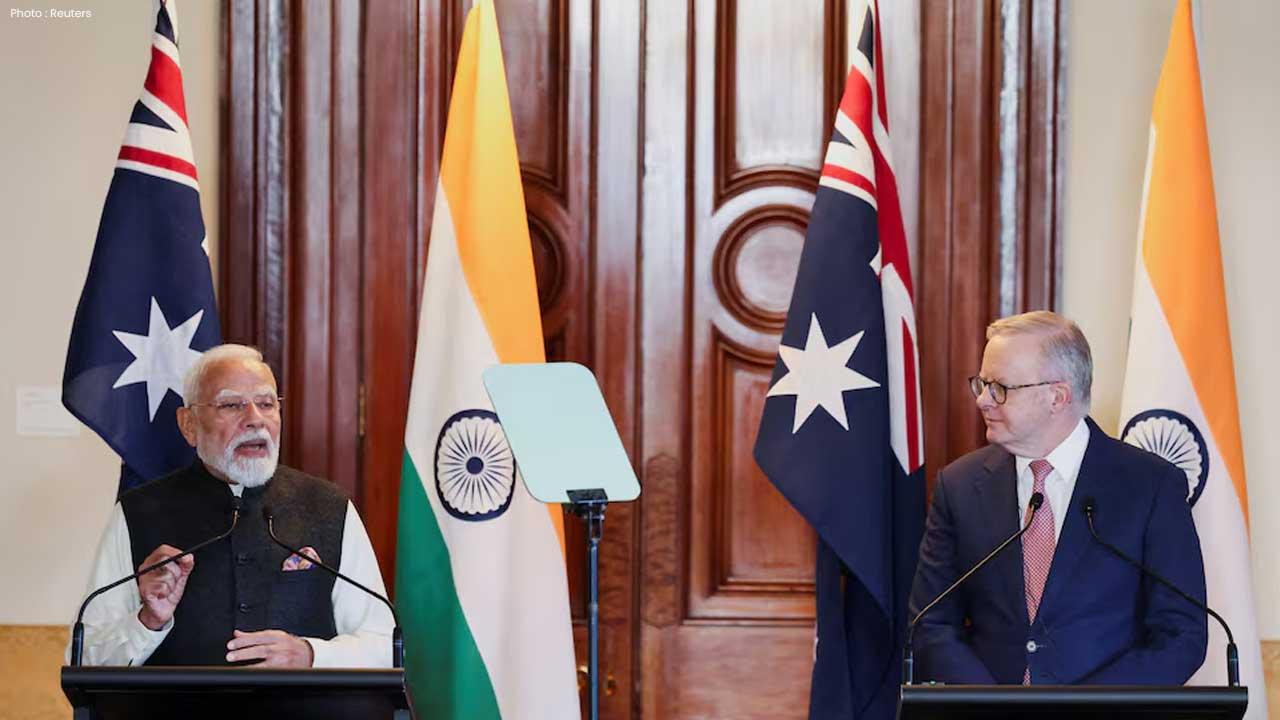
The agreement was finalized on Thursday, July 9, during Indian Prime Minister Narendra Modi's official visit to Australia, where he met Australian Prime Minister Anthony Albanese in Melbourne. Alongside the uranium deal, both countries agreed to deepen cooperation in renewable energy, green hydrogen, critical minerals, and infrastructure investment.
The partnership is expected to boost energy security, economic cooperation, and regional strategic ties while supporting the transition toward low-carbon energy sources.
Australia to Supply Uranium for India's Nuclear Energy Program
Under the new agreement, Australia will export uranium to India exclusively for peaceful purposes, including electricity generation through nuclear power plants.
India has been seeking access to Australia's vast uranium reserves for years as part of its plan to expand nuclear power capacity. The Indian government has set an ambitious target of achieving 100 gigawatts (GW) of nuclear energy capacity by 2047, helping reduce dependence on fossil fuels and meet climate goals.
Australian Prime Minister Anthony Albanese said the agreement opens a new market for Australia's resource sector while helping India increase its share of non-fossil fuel energy.
He described Australia and India as "close partners and even closer friends," emphasizing the growing strategic relationship between the two nations.
Although both countries signed a civil nuclear cooperation agreement in 2014, uranium exports remained limited because of concerns that Australian uranium could potentially be diverted to India's nuclear weapons program.
Read Also :- Trump Believes Putin and Zelenskyy Want Peace in Ukraine
The new arrangement includes safeguards ensuring that Australian uranium will be used only for peaceful civilian nuclear energy production.
India and Australia Expand Clean Energy Cooperation
Beyond uranium exports, both leaders announced plans to strengthen collaboration across several clean energy sectors.
The agreement includes cooperation on:
Renewable energy development
Green hydrogen production
Critical minerals supply chains
Clean technology investment
Low-carbon industrial projects
Energy transition initiatives
Prime Minister Narendra Modi said Australia's technology, natural resources, and investment capabilities could significantly support India's transition toward cleaner energy.
He also highlighted opportunities to collaborate on low-carbon aluminium production, an industry that is expected to play an important role in reducing industrial emissions.
Modi Invites Australian Investment in India
During a business forum in Melbourne, Prime Minister Modi encouraged Australian companies and investors to expand their long-term investments in India.
He invited investment in major infrastructure sectors, including:
Roads
Railways
Ports
Urban development
Logistics
Smart city projects
Modi described India as a safe, stable, and sustainable destination for global investment, emphasizing the country's rapidly growing economy and expanding infrastructure needs.
AustralianSuper Announces Major Investment
Australia's largest pension fund, AustralianSuper, also announced additional investment in India.
The fund confirmed it will invest another A$500 million (approximately US$347 million) in India's National Investment and Infrastructure Fund (NIIF).
The investment reflects growing confidence among Australian institutional investors in India's long-term economic growth and infrastructure development.
Albanese Calls Modi a "Living Bridge"
Speaking after their meeting, Prime Minister Anthony Albanese referred to Narendra Modi as a "living bridge" between Australia and India.
He said Modi's leadership has helped reshape the economic relationship between both countries and opened new opportunities for trade, investment, technology, and strategic cooperation.
Australia views India as one of its fastest-growing economic partners and an increasingly important market as it seeks to diversify exports beyond China.
Growing Australia-India Trade Relationship
India has become Australia's fifth-largest trading partner, following China, Japan, the United States, and South Korea.
Economic relations between the two countries have expanded significantly over the past decade through increased trade, education partnerships, defence cooperation, and investment.
Australia is also home to approximately one million people of Indian origin, making the Indian diaspora one of the country's largest and fastest-growing communities.
This strong people-to-people connection continues to strengthen diplomatic and economic ties.
Modi Addresses Indian Community in Melbourne
During his visit, Prime Minister Modi was scheduled to address thousands of members of the Indian community at a large indoor arena in Melbourne.
The event attracted significant public attention and security arrangements.
Outside the venue, a small group of far-right protesters demonstrated against immigration, carrying anti-immigration banners.
However, they were greatly outnumbered by thousands of supporters waving Indian flags, playing drums, and welcoming the Indian Prime Minister.
Large public gatherings have become a regular feature of Modi's overseas visits, especially in countries with large Indian diaspora communities, including Australia, the United States, and the United Kingdom.
Modi Continues Indo-Pacific Diplomatic Tour
Australia is the second stop on Prime Minister Modi's regional diplomatic tour.
Before arriving in Australia, he visited Indonesia, where India signed several agreements covering agriculture, defence cooperation, and the BrahMos cruise missile system.
Following his Australia visit, Modi is scheduled to travel to New Zealand before returning to India.
Strategic Importance of the Agreement
The uranium export agreement represents more than an energy partnership.
For India, it supports long-term energy security and clean electricity generation while helping achieve ambitious climate and development goals.
For Australia, it creates new export opportunities, strengthens economic diversification beyond China, and reinforces strategic partnerships across the Indo-Pacific region.
The expanded cooperation in renewable energy, green hydrogen, and critical minerals also aligns with both countries' commitment to achieving lower carbon emissions and building resilient clean energy supply chains.










PM Modi Pays Tribute to Mahatma Gandhi, Urges People to Support Khadi
PM Modi pays tribute to Mahatma Gandhi on Gandhi Jayanti and urges citizens to support Khadi and the

Amazon Seeks to Offload $8 Billion in Nvidia Chips to Investors
Amazon plans to move $8 billion in Nvidia chips to investors, using a new financing model to strengt

Samsung Raises Galaxy S26 Prices as Memory Chip Costs Rise
Samsung raises Galaxy S26 prices in South Korea as rising memory chip costs put pressure on smartpho

Lewis Hamilton Calls Singapore Grand Prix One of F1's Toughest Races
Lewis Hamilton discusses the demanding Singapore Grand Prix and brings Plus44 and Almave to Singapor

Denmark's Pandora Opens World's Largest Jewellery Factory in Vietnam
Pandora opens its largest jewellery factory in Vietnam, expanding global production, strengthening s

Gautam Gambhir Questions Batting-Friendly Pitches After India's Record ODI Chase
Gautam Gambhir questions batting-friendly ODI pitches after India’s record chase, calling for a bett

