
You have not yet added any article to your bookmarks!
Join 10k+ people to get notified about new posts, news and tips.
Do not worry we don't spam!
Post by : Rohit Dhiman
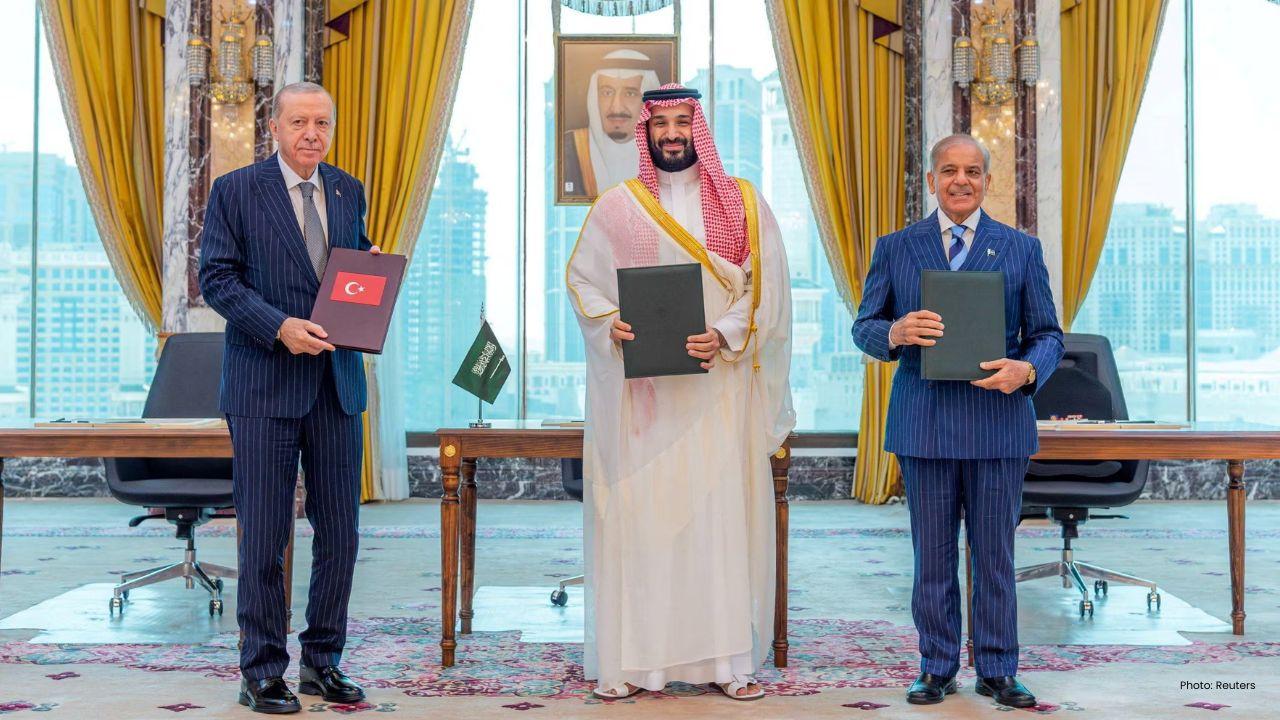
The signing of a joint defence agreement by Saudi Arabia, Türkiye and Pakistan in Mecca on August 7, 2026, could mark an important development in the evolving security landscape of West Asia. The agreement brings together three countries with distinct strategic positions. Saudi Arabia is a major Persian Gulf power with significant economic and energy influence. Pakistan is a South Asian nuclear-armed state, while Türkiye is a member of the North Atlantic Treaty Organization. Their decision to deepen defence cooperation therefore carries implications beyond a conventional bilateral or regional security arrangement. The pact was signed by Saudi Crown Prince Mohammed bin Salman, Turkish President Recep Tayyip Erdoğan and Pakistan Prime Minister Shehbaz Sharif. Their meeting in Mecca underlines the growing importance of cooperation among Muslim-majority countries at a time when regional security relationships are undergoing significant changes.
For years, West Asia's security environment has been shaped by a combination of traditional alliances, rivalries and external military partnerships. The new Saudi-Türkiye-Pakistan arrangement points towards a possible diversification of those relationships. Rather than depending exclusively on established security partnerships, regional powers appear increasingly interested in developing additional strategic links. The participation of Türkiye and Pakistan alongside Saudi Arabia gives the agreement a wider geographic dimension, connecting the Persian Gulf with South Asia and the eastern Mediterranean. The development also reflects the changing nature of defence diplomacy in the region, where countries are seeking greater strategic flexibility while responding to shifting regional circumstances.
Read Also: Iran Sets Preconditions for Strait of Hormuz Reopening
The agreement does not, by itself, establish a completely new regional security system. However, it could become part of a broader transformation in how countries across West Asia approach defence cooperation. Its significance will ultimately depend on how the three countries implement the agreement and whether cooperation expands into areas such as military coordination, training, intelligence sharing or other forms of strategic engagement. For India and other countries closely connected to the Gulf region, these developments will be important to watch. A closer Saudi-Türkiye-Pakistan relationship could influence the region's diplomatic calculations and reshape emerging patterns of cooperation. For now, the agreement is best viewed as an important signal: West Asia's security architecture is evolving, and regional powers are increasingly looking beyond traditional alignments.










PM Modi Pays Tribute to Mahatma Gandhi, Urges People to Support Khadi
PM Modi pays tribute to Mahatma Gandhi on Gandhi Jayanti and urges citizens to support Khadi and the

Amazon Seeks to Offload $8 Billion in Nvidia Chips to Investors
Amazon plans to move $8 billion in Nvidia chips to investors, using a new financing model to strengt

Samsung Raises Galaxy S26 Prices as Memory Chip Costs Rise
Samsung raises Galaxy S26 prices in South Korea as rising memory chip costs put pressure on smartpho

Lewis Hamilton Calls Singapore Grand Prix One of F1's Toughest Races
Lewis Hamilton discusses the demanding Singapore Grand Prix and brings Plus44 and Almave to Singapor

Denmark's Pandora Opens World's Largest Jewellery Factory in Vietnam
Pandora opens its largest jewellery factory in Vietnam, expanding global production, strengthening s

Gautam Gambhir Questions Batting-Friendly Pitches After India's Record ODI Chase
Gautam Gambhir questions batting-friendly ODI pitches after India’s record chase, calling for a bett

